
A Rocky Road
Thomas Clarkson founded his bankruptcy practice in 1864, which would become Clarkson, Gordon & Co., and ultimately the Canadian firm of Ernst & Young LLP.1 The history of the company under Thomas's leadership is described here.
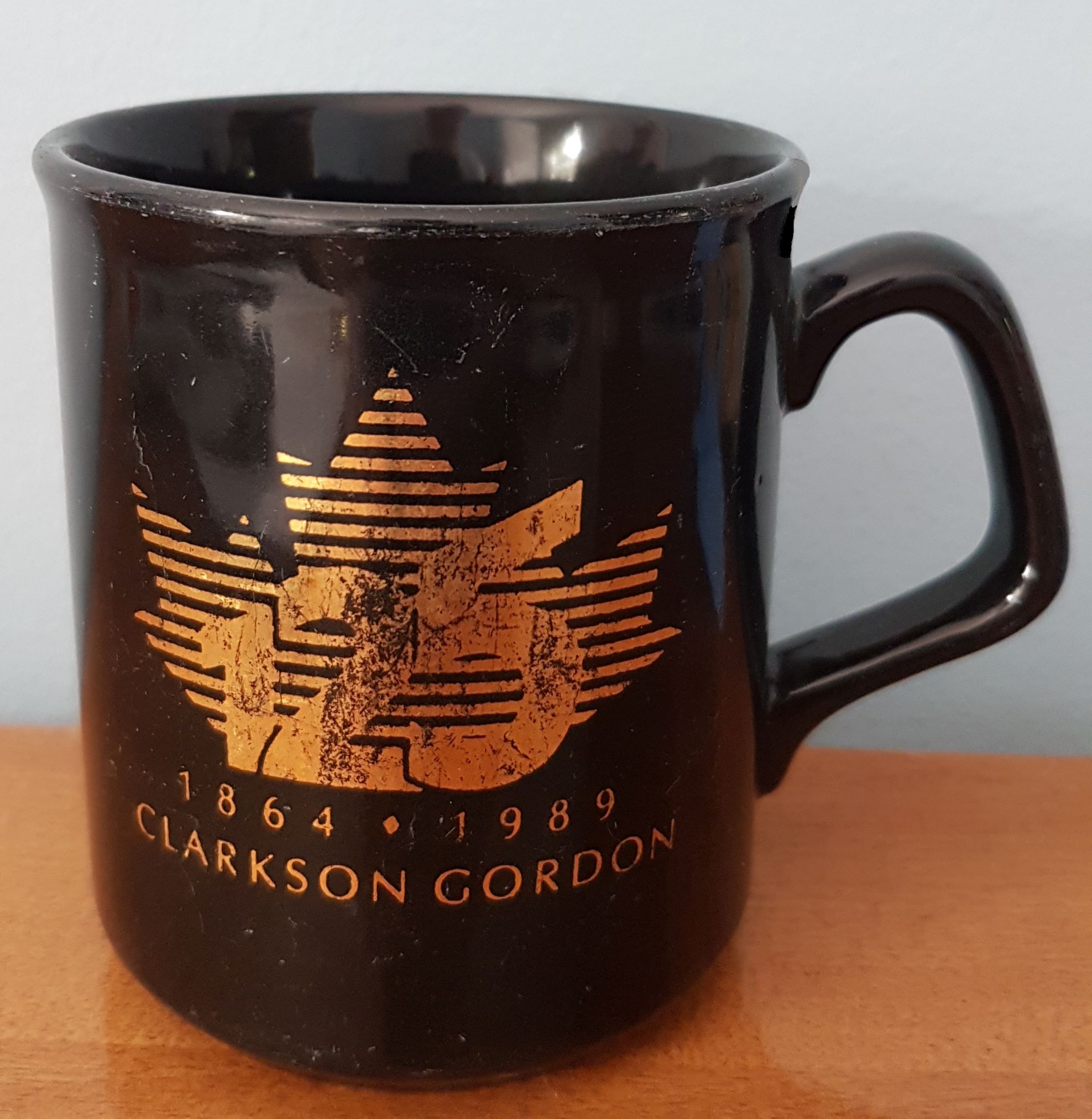
Thomas left his official assignee business in relatively good shape,2 though he did not stay healthy long enough to pass it smoothly to his son E.R.C., as he had passed his other businesses to other sons. E.R.C. likely joined the firm as a clerk in late 1870,3 and so had just more than one full year working at the firm before his father suffered a stroke and was forced to retire.4 At this time, E.R.C. was only 19 years old.5
A Mad Scramble
This led to both a ten-year period of relative instability in the firm, and also the birth of the accounting practice.
When Thomas unexpectedly had his stroke, no one else in his employ was an official assignee. This led to a mad scramble to decide how to keep the business going. While it may have been Thomas's intention that E.R.C. would follow in his footsteps,6 apparently an official assignee had to be 25 years old,7 but E.R.C. was only 19, so he wouldn't even be eligible to be an official assignee for another six years. Instead Thomas's senior employee, William F. Munro,8 quickly qualified as an official assignee9 and then formed a partnership with E.R.C.10, 11
The firm struggled to be properly described. The first advertisement of the newly named firm appeared in The Globe on June 11, 1872,12 and the second on June 18,13 one week later. These two advertisements used different names for the firm, showing the haste with which they were put together.
The Toronto City Directory for 1872-73 was updated to June 25 of that year—just two weeks after the first advertisement—so the inclusion of Clarkson & Munro in the directory was one of the last changes before publication.14 Last minute changes to a document can often introduce unintended errors, and so it was with the 1872-73 directory. The following errors were observed:
- First, the firm was said to be a partnership between Thomas (not E.R.C.) and William F. Munro.15
- Second, E.R.C. was still described as a clerk, even though he was a partner.16
- Third, in the section arranged by profession, under "Coal and Wood Dealers"—they were agents for a Cleveland coal producer—the firm is named as "Clarkson & Morris".17
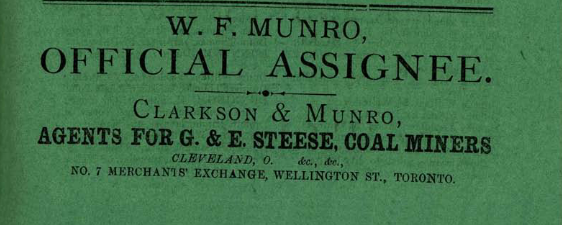
At least the advertisement the firm placed on green paper in the middle of the directory, pictured at left, seems to have been properly written.18
The firm would move beyond this regrettable re-start to try to regain its footing.
The Birth of an Accounting Firm
The story of how this bankruptcy firm also became an accounting firm started at the very beginning of Thomas's bankruptcy business. When Thomas established his business as an official assignee in 1864 and 1865, one of the first steps he needed to take was to hire an accountant.19 Understanding accounting was critical for an official assignee, since he or she had to pore over a bankrupt person's books to assess the bankrupt person's assets and to see who owed what to whom. So Thomas, and, in fact, every official assignee, had the skills on board necessary to provide accounting services to clients.
Added to this, Thomas's meeting regarding J.G. Beard and Sons shows that J.G. Beard and Sons was a well-established company that lacked even basic accounting knowledge.20 To the extent that this case was typical, the demand for accounting services would also be evident to Thomas, and indeed to every official assignee.
Every official assignee therefore had the ability to supply accounting services, and the opportunity to see the demand for accounting services. All it took to connect potential supply with demand was someone with entrepreneurial spirit to pursue the accounting market. For the firm that Thomas started, that entrepreneur would be Thomas's son E.R.C.
At first, Clarkson & Munro referred to themselves as "General Brokers" or "General Agents"21 because they had inherited the role as agent for a Cleveland, Ohio coal company from Thomas, as can be seen in the 1872-73 directory of Toronto.22 The first indication that Clarkson & Munro had moved beyond being merely agents and into accounting was the Toronto directory updated to March 1, 1874, in which their entry read as follows:23
CLARKSON & MUNRO, accountants and official assignees, Exchange buildings, Wellington e
For the first time, the firm was listed as one of a handful of "Accountants" in Toronto.24 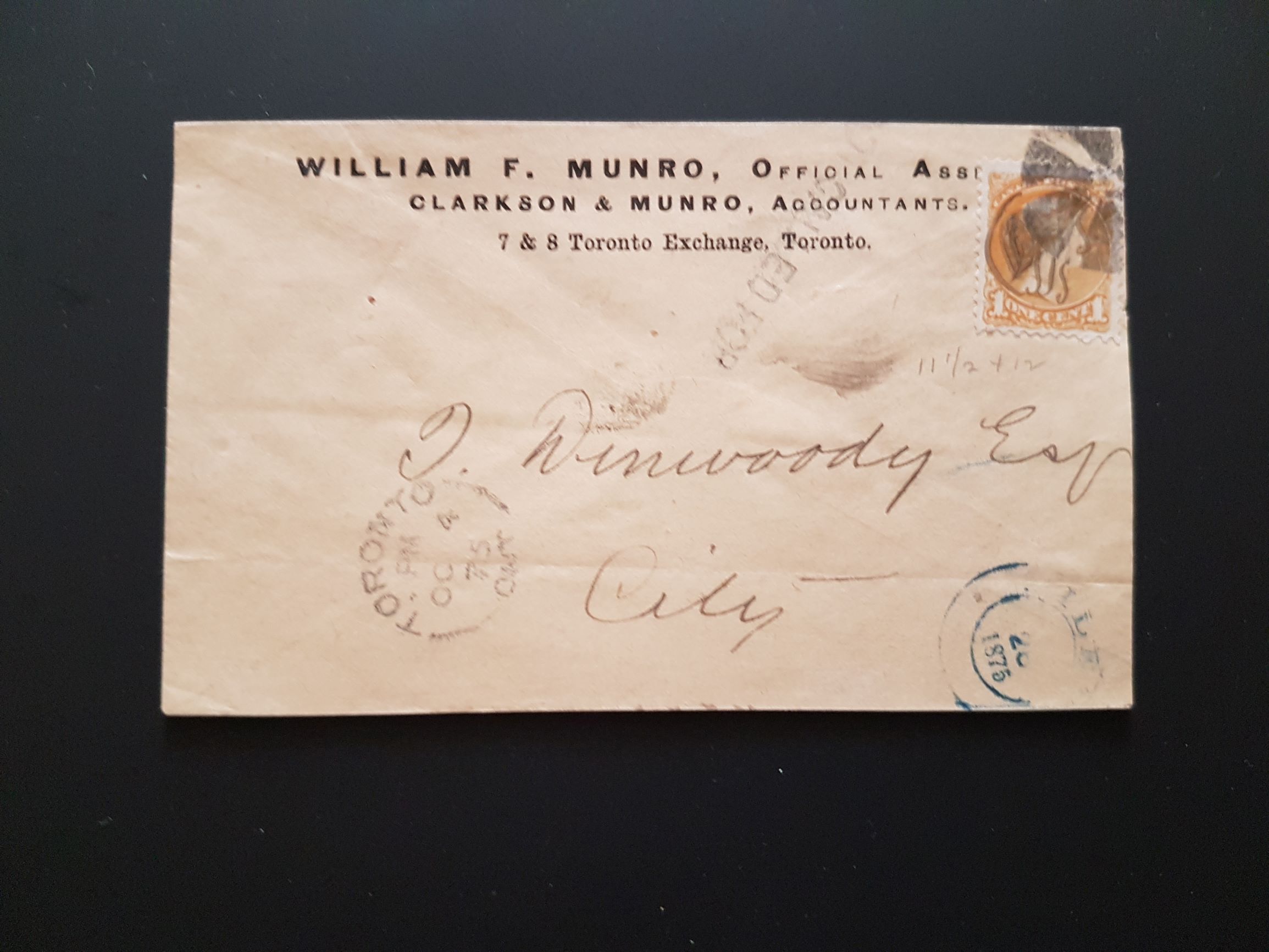 The envelope shown at right, which is an example of the firm's letterhead from that period, is postmarked 1875 and confirms that the firm was offering accounting services to clients.25 This conversion from agents to an accounting firm thus occurred earlier than was previously known.26
More Instability
To continue his father's business, all E.R.C. needed to do was to maintain the partnership with William F. Munro until E.R.C. was old enough to become an official assignee himself.
But it was not to be.
The two partners went their separate ways in 1877,27 and the split does not appear to have been amicable, as they went into direct competition with each other.28
E.R.C. then found himself in a familiar predicament: he was not an official assignee, so to continue the business, he needed to partner with someone who was. This time, he chose John Turner, who had qualified as an official assignee, and who also ran a boot and shoe manufacturing business.29 They formed a partnership called Turner, Clarkson and Company.30 During his partnership with John Turner, E.R.C. made progress on one of his immediate goals: he, too, qualified as an official assignee.31 So both partners were practicing as official assignees, or trustees as they sometimes referred to themselves.32
In 1879, E.R.C. was one of the hosts of a meeting of the accounting profession in Ontario that led to the formation of the Institute of Accountants and Adjusters of Canada, and a key step in the development of the Chartered Accountant designation in Canada. That same year, E.R.C. was elected to the Council of the Institute.33
If he could have seen the future, John Turner would have known that he should focus on the official assignee business. But instead, he followed his customers' feet. After a period of acting as both official assignee and a boot and shoe manufacturer,34 John Turner split with E.R.C. in November 1880 and devoted himself fully to manufacturing.35
Within a week of E.R.C. and John Turner dissolving their partnership, E.R.C. formed yet another partnership, this time with one Robert Wemyss.36,37 They described themselves as "Accountants and Stockbrokers".38 I imagine it was Robert Wemyss's idea that the partnership should act as stockbrokers, because E.R.C. had never called himself a stockbroker before, and he quickly dropped the name afterwards.39
The partnership of Wemyss and Clarkson was short-lived, lasting just over seven months.40 It must have been forgettable because it was not mentioned in either of the two histories of the firm,41,42 nor was it even mentioned by E.R.C. when he wrote an autobiographical sketch for the Board of Trade in 1893.43
Chartered Accountant
Finally, in 1881, E.R.C. decided to go it alone, bringing an end to the instability.44 E.R.C. then petitioned for a Charter of Incorporation and sat for the first examinations for the Chartered Accountant designation, which were the two requirements to obtain that designation,45, 46 allowing the firm to be described in Toronto directories as follows:47
Clarkson E R C, Chartered Accountant and Official Assignee
The business that Thomas started and that E.R.C. continued had survived the period of instability, and had graduated into the higher echelons of the accounting and bankruptcy professions, where it remains today.
Footnotes
1The photograph shows a mug celebrating the 125th anniversary of Clarkson Gordon: 125th Anniversary Mug, Andrew G. Clarkson (photographer), September 14, 2020.
2A significant number of new clients were signed up in late 1871. See the list of clients here.
3Irwin, W. Henry, City Directory for 1871-1872, Toronto: Daily Telegraph Printing House, 1871, p. 52.
4See an analysis of the timing of Thomas's stroke here.
5Province of Ontario Certificate of Registration of Death for Edward R. C. Clarkson, April 8 1931.
6Clarkson, Gordon & Co., The Story of the Firm, 1864-1964: Clarkson, Gordon & Co., Toronto: University of Toronto Press, 1964, p. 13.
7E.R.C. didn't become an official assignee until 1877, as shown in the text on this page, even though it would have been in his best interests to achieve such an appointment sooner, which is why I think age 25 may have been the minimum set by the Toronto Board of Trade.
8For example, Sutherland, James, City of Toronto Directory for 1867-68, Toronto: W. C. Chewett & Co, 1867, p. 209.
9"William F. Munro, Official Assignee", The Globe, June 11, 1872, p. 1.
10Ibid.
11"Clarkson, Munro and Co.", The Globe, June 18, 1872, p. 1.
12"William F. Munro, Official Assignee", The Globe, June 11, 1872, p. 1.
13"Clarkson, Munro and Co.", The Globe, June 18, 1872, p. 1.
14Irwin, Wm. Henry, Toronto City Directory for 1872-83. (corrected to June 25th), Toronto: Telegraph Printing House, 1872, p. 48.
15Ibid.
16Ibid.
17Ibid, p. 216.
18Ibid, page after p. 64.
19"Official Assignee under the Insolvent Acts of 1864 and 1865",The Globe, December 18, 1865, p.2.
20"Meeting of Creditors", The Globe, May 29, 1869, p. 1.
21"Clarkson, Munro and Co.", The Globe, June 18, 1872, p. 1.
22Irwin, Wm. Henry, Toronto City Directory for 1872-83. (corrected to June 25th), Toronto: Telegraph Printing House, 1872, p. 48.
23Fisher & Taylor's Toronto Directory for the Year 1874, Toronto: Fisher & Taylor, 1874, p. 201.
24Ibid, p. 23.
25Envelope addressed to J. Dinwoody from Clarkson and Munro, 1875.
26See the discussion of the development of the accounting practice, and especially the vagueness about the year in which that occured, in Clarkson, Gordon & Co., The Story of the Firm, 1864-1964: Clarkson, Gordon & Co., Toronto: University of Toronto Press, 1964, p. 15.
27"Turner, Clarkson, & Co." in The Globe, August 28, 1877, p. 3.
28Toronto Directory for 1878, Toronto: Might & Taylor, pp. 365, 432.
29Ibid, p. 432.
30Ibid.
31"By Scott, Sutherland & Co.", The Globe, May 3, 1879, p. 6.
32For example, "By Scott, Sutherland & Co.", The Globe, October 21, 1880, p. 10.
33Edwards, H. Percy, "Three Score Years" in A History of Canadian Accounting Thought and Practice, George J. Murphy (ed.), New York and London: Garland Publishing Inc., 1993, p. 114; Article originally published February 1940.
34Toronto Directory for 1880, Toronto: Might & Co., 1880, p. 428.
35Toronto Directory for 1881, Toronto: Might & Co., 1881, p. 434.
36See successive ads for the same sale, "Wholesale Stock of Tweeds, Cloths, and Tailors' Trimmings", The Globe, Nov. 11, 1880, p. 6, and Nov. 16, 1880, p. 6.
37Ibid.
38Toronto Directory for 1881, Toronto: Might & Co., 1881, p. 443.
39See, for example, Toronto Directory for 1882, Toronto: Might & Co., 1882, p. 231.
40"Dissolution of Partnership", The Globe, July 5, 1881, p. 7.
41Clarkson, Gordon & Co., The Story of the Firm, 1864-1964: Clarkson, Gordon & Co., Toronto: University of Toronto Press, 1964.
42MacKenzie, David, The Clarkson Gordon Story: In Celebration of 125 Years, Toronto: University of Toronto Press, 1989.
43The Toronto Board of Trade: "A Souvenir Number", Montreal and Toronto: Sabiston Lithographic & Publishing Co., 1893, p. 150.
44"By Peter Ryan, Successor to Sutherland & Co." in The Globe, April 5, 1882, p. 8.
45Clarkson, Gordon & Co., The Story of the Firm, 1864-1964: Clarkson, Gordon & Co., Toronto: University of Toronto Press, 1964, p. 15.
46Edwards, H. Percy, "Three Score Years" in A History of Canadian Accounting Thought and Practice, George J. Murphy (ed.), New York and London: Garland Publishing Inc., 1993, pp. 114-115; Article originally published February 1940.
47Toronto Directory for 1882, Toronto: Might & Co., 1882, p. 231.
