
Thomas Clarkson of Toronto
A Biography Constructed from the Evidence
The story of Thomas Clarkson of Toronto is a story of household goods by the shipful, whiskey by the gallon, and an astonishing number of children.
Thomas Clarkson of Toronto rose to the pinnacle of the business world in Toronto, Canada in the nineteenth century and helped to found several institutions that are integral parts of Canadian society today. Looking at Thomas's life from the perspective of the twenty-first century, in which truth seems to be devalued by public officials on a daily basis, it now seems particularly important to focus on facts and evidence. This biography examines the primary and secondary evidence about Thomas's life to construct a more detailed account than has previously been published.
The evidence will show that Thomas Clarkson of Toronto was born in Susworth, Lincolnshire, trained in England and Europe, and spent most of his career in Toronto, Canada, where he rose to become one of the foremost businessmen of that city, but not before showing a surprising propensity to uproot his growing family and move large distances in the search for economic opportunity. He sat on the boards of many companies and other organizations. He was a natural businessman who could sell almost anything, but not a natural public speaker. He was described as "amiable", "efficient", and "zealous". He enthusiastically worked for freer trade, building infrastructure, loosening restrictions on lending money, and developing possibilities of the interior of both Ontario and North America. Thomas helped to found several major institutions that are important parts of Canadian society today, and guided those and others through their early years, including the Toronto Region Board of Trade, the Toronto-Dominion Bank, the Canadian firm of Ernst & Young LLP, Ports Toronto, and the Toronto General Hospital.
Thomas is shown below in the only known photograph of him,1 this particular copy having been hand-coloured, and deposited by J. Ross Robertson with the Toronto Public Library more than one hundred years ago. A black and white version of the same photograph has been posted online by family members.
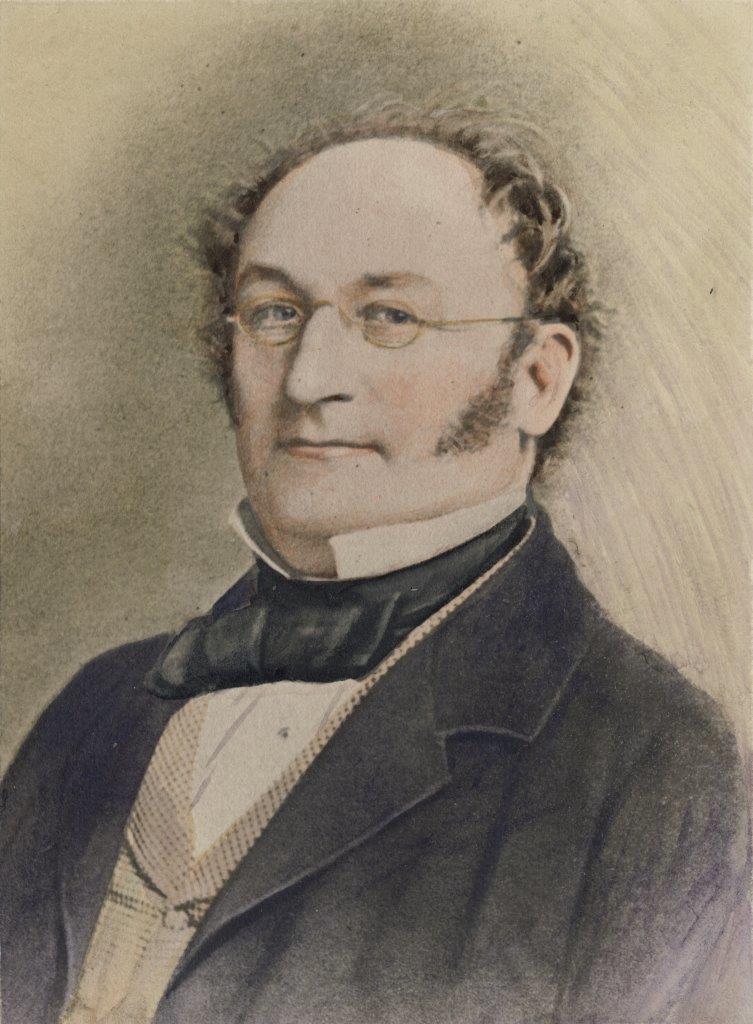
Thomas Clarkson of Toronto (1802-1874) should not be confused with another Thomas Clarkson (1760-1846),2 who was a champion of the anti-slavery movement, lived his whole life in England but travelled widely, and was in a very different generation from Thomas Clarkson of Toronto.
This biography includes especially the first account yet published of Thomas's life before immigrating to Canada, an account of an important speech on free trade Thomas made to a well-attended public meeting in Toronto, and an analysis of the earliest days of the company he founded that became the accounting firm once called Clarkson, Gordon & Co., now known as the Canadian partnership of Ernst & Young LLP. This biography also provides more detail about the events in his life that have already been chronicled by others. Before this biography, the primary sources on Thomas's life were the entry on Thomas in The Dictionary of Canadian Biography,3 and the opening chapters of a pair of books issued by the accounting firm then known as Clarkson, Gordon & Co., The Story of the Firm 1864-1964 and The Clarkson Gordon Story.4, 5
This account is organized into eight parts and a conclusion:
- Part 1: Fewer Than Thirty Buildings
- Part 2: Christian Fortitude
- Part 3: Cold and Stormy—Arrival in Canada
- Part 4: Toronto in the 1830s and 1840s
- Part 5: Zealous and Efficient—Toronto in the 1850s
- Part 6: Milwaukee in the 1860s
- Part 7: Toronto Redux
- Part 8: Final Years
- Conclusion
Part 1: Fewer Than Thirty Buildings
Like so many immigrants to Canada, Thomas had humble origins. On January 26, 1802, he was born in a rural hamlet, Susworth, on the east bank of the River Trent in Lincolnshire, England.6 He was born nine months after his parents' marriage.7
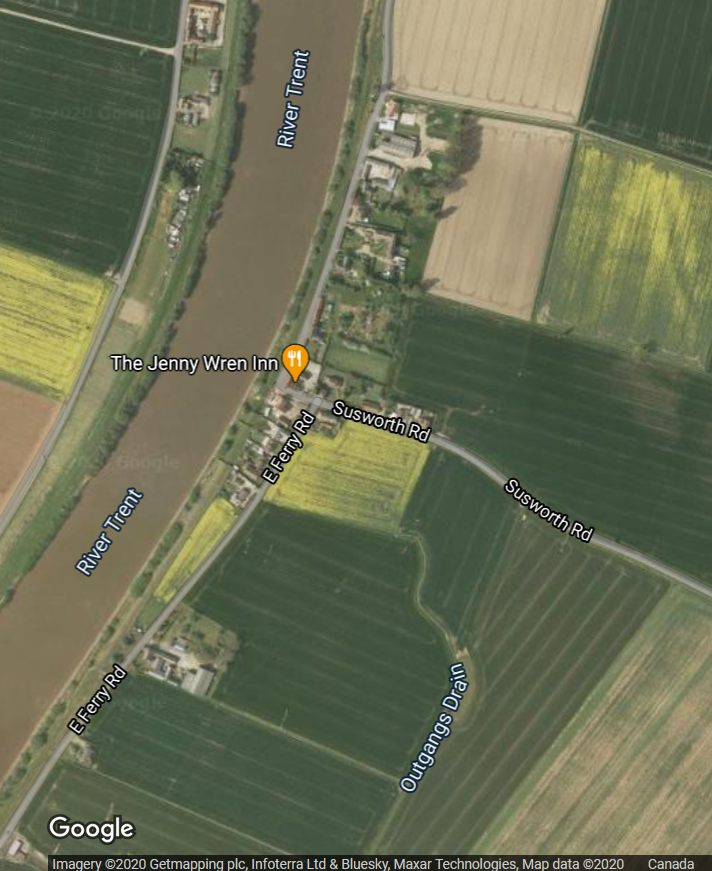
Today, Susworth has fewer than thirty buildings in total, as can be seen in the satellite image at right,8 and it is doubtful that it ever was much larger. Susworth resembles other settlements north of Gainsborough, Lincolnshire, its layout reflecting dependence on the river and the river's function as a major transportation route used for commerce, with a single street running parallel to the river, and a rural highway intersecting at in a "T" junction.9 Gainsborough is a town close to Susworth, upstream along the River Trent.
Of these small number of buildings, at least one is well known today outside of Susworth, the Jenny Wren Inn.10 This pub is of particular interest for our purposes, since it is over 300 years old, being previously known as The White Horse. Thus, the pub was there when Thomas lived in Susworth as a boy. Since Thomas's father was for some of his working life a "victualler",11 Thomas quite possibly had more than a passing familiarity with the pub.
Susworth, which is documented by name at least from about 1200,12 is in a part of Lincolnshire that joined the Catholic rebellion called the Lincolnshire Rising in 1536.13 This part of Lincolnshire was a source of some of the Pilgrims, religious refugees, who travelled to the United States on the Mayflower in 1620.14 In sharp contrast to this history of religious independence, Thomas remained loyal to the Church of England throughout his life, even despite close family members joining other denominations.15, 16
For at least some of Thomas's years growing up, his father was a maltster in the Susworth vicinity.17 Please see the page on his parents, John and Elizabeth Clarkson, for more information on the family during Thomas's childhood and teenage years.
Thomas's adult life can be understood by examining his family life and his business life. Considerable evidence about both has survived.
Thomas married Elizabeth Faram on March 12, 1823 in All Saints Church in Gainsborough.18 Elizabeth was a minor at the time, according to their marriage license application.19 The family information records the couple having two children together. Like many amateur genealogies, however, the family information is not reliable when it comes to details. For example, it said that Thomas's first wife was named Elizabeth Farnham (despite the fact that their first child's middle name was Faram) and that they were married in 1821.20 Based on christening records, the first three known children of Thomas and Elizabeth are as follows:21
- Betsy Faram Clarkson, (1823-1909),
- Thomas Brown Clarkson (1825-c1826), and
- Thomas Clarkson, (1827-?).
The oldest child, Besty Faram, immigrated to Canada with her father,22 and lived to old age.23 In 1846, she married Matthew Teefy24 (by eloping, according to family information25), who was a long-time postmaster and secretary treasurer of Richmond Hill.26 Richmond Hill was then a village and today is a Toronto suburb.
The second child, Thomas Brown, was not known to recent generations of the Clarkson family.27 Since the third child was also named Thomas, Thomas Brown must have died within two years of being born. The source of his middle name, Brown, is not known for certain, but note that one of the two witnesses to Thomas and Elizabeth's marriage was a Mary Brown.28
The third child, Thomas, is more difficult to properly identify. A child named Thomas grew to adulthood (hereafter referred to as "Thomas Jr."), but it is not immediately clear whether Thomas Jr. is this third child. It is possible that they are the same person, but it is also possible that this third child died and Thomas Jr. is a subsequent, fourth or later child. I show farther below that the latter is almost certainly the case as I discuss Thomas's entry in the 1842 Census of Canada. However, more information about Thomas's early life is first required in order to interpret that entry.
Kingston-upon-Hull
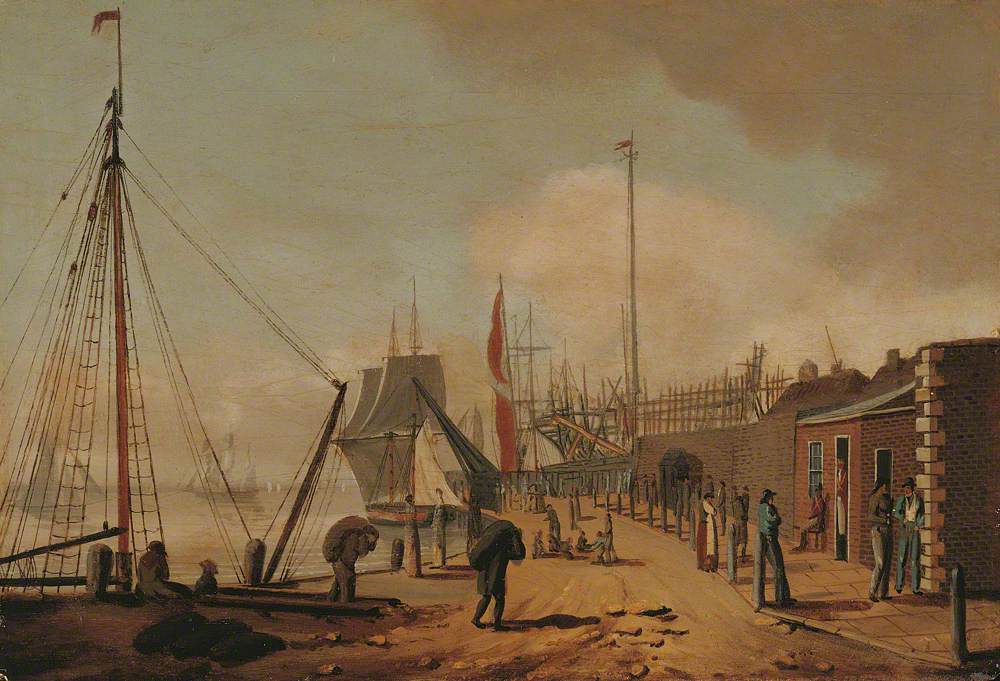
As Thomas reached adulthood, he came to live in Kingston-upon-Hull in Yorkshire.
The name of Kingston-upon-Hull is frequently shortened to "Hull", as it was in Thomas's day. Hull was then a major port near the east coast of England where the Hull River meets the Humber River. The Humber is quite wide near Hull, so ocean-going vessels had no trouble navigating up the river to dock at one of Hull's many docks. The Humber bank in Hull is pictured at right in 1829.29
Thomas's marriage was reported in The Lincoln Rutland and Stamford Mercury on March 13, 1823 as follows:30
At Gainsboro', on Wednesday the 12 inst., Mr. J. Clarkson, wharfinger, of Hull, to Miss Faram, eldest daughter of Mr. Faram, farmer, of Misterton.
Aside from getting Thomas's first initial wrong—T's and J's were often written similarly in those days—the announcement has several interesting pieces of information: that Thomas was a wharfinger, that Elizabeth Faram was a farmer's daughter, and that Thomas lived in Hull.
A wharfinger is a person or company that manages a wharf by directing the movement of freight around the wharf, and overseeing the loading and unloading of docked ships. The experience Thomas gained as a wharfinger would provide a good basis for his future work with ships and cargoes in Toronto.
The fact that Elizabeth Faram's father was a farmer is significant because throughout his life, Thomas would have business interactions with families that married into his. But his father-in-law being a farmer would have limited Thomas's ability to do business with the Faram family. In fact, we have no evidence that Thomas ever had business relations with his first wife's family.
The most important fact from the marriage notice is that Thomas lived in Hull. Hull is situated near Susworth, where Thomas grew up. It is Thomas's connection to Hull that allows us to know more about his life in the Old World before immigration to the New World. Identifying Thomas in Hull requires the examination of the directories of that city that are readily available for the 1820s, of which there were three: those in 1823, 1826, and 1828-29.
In the 1823 directory, there were two Thomas Clarksons living in Hull, one of whom was a glove maker, and the other a ship chandler.31 Neither of these appear to be our Thomas. This suggests that Thomas was relatively new to Hull at the time of his marriage: the three directories were current for the named years, so the 1823 directory actually reflects the inhabitants of Hull by the end of 1822.
However, the 1826 and 1828-29 directories do reflect Thomas and his family. One name in particular jumps out, a partnership with the unusual name Smiths & Clarkson,32 which is interesting because Thomas's mother's maiden name was Smith. Smiths & Clarkson can be shown to be a partnership among a John Smith, a Henry Smith, and a Thomas Clarkson.33 The hypothesis that this partnership has something to do with our Thomas is especially appealing because Smiths & Clarkson were the agents for packet boats going between Hull and Gainsborough,34 right past the hamlet of Susworth where Thomas grew up. Unfortunately, the name Smith was so common in England at that time that this connection could be entirely coincidental—in fact, there were other associations of Clarksons and Smiths in Hull that appear to have nothing to do with our Thomas or his family.35 Only through analysis of the 1826 and 1828-29 directories can we reach a conclusion on which entries relate to Thomas Clarkson of Toronto.
Consider the following selection of entries in the two directories:36, 37
Name and Profession 1826 Address 1828-29 Address Thomas Clarkson, Wharfinger 52 High St. - John Clarkson, Mustard Manufacturer 52 High St. - Smiths & Clarkson, Broker and Agent 52 High St. - Clarkson & Carter, Mustard Manufacturers 52 High St. 16 Humber Dock Walls Kirkus & Co., Shipping Agents New Dock Walls 16 Humber Dock Walls John Smith & Co., Merchants/Fire and Packet Agents 21 High St. 52 High St.
To see the significance of these entries, it is important to know that Thomas's brother John married Mary Ann Kirkus in Hull in 1827.38 The fact of Mary Ann's maiden name is confirmed by two independent sources in the Toronto area, where John and Mary Ann would ultimately move.39, 40 With this in mind, observe the partnership Clarkson & Carter in the table above. Clarkson & Carter can be shown to be a partnership between a John Clarkson and a Richard Carter.41 The partnership co-locates with a Thomas Clarkson and Smiths & Clarkson in 1826, but then co-locates with Kirkus & Co. in 1828-29. The last name Kirkus is uncommon enough by itself, but the pairing with Clarkson is a very uncommon combination indeed. This unusual pairing proves beyond a reasonable doubt that the Clarkson in Clarkson & Carter is Thomas's brother John. John evidently operated out of his father-in-law's place of business after marrying his daughter. Based on the 1826 directory, this, in turn, confirms that the Thomas Clarkson listed as wharfinger and the Thomas Clarkson who was a partner in Smiths & Clarkson are both Thomas Clarkson of Toronto.
We can use this information to walk through Thomas's time living in Hull:
- The earliest mention of Thomas is as a wharfinger in the marriage notice of 1823.42 This profession is repeated on the birth records of Thomas's children Betsy Faram and Thomas Brown.43, 44
- Thomas himself actually formed a partnership with Jeremiah Kirkus, called Kirkus & Co., which was dissolved on November 6, 1824.45 As a shipping agent, Kirkus & Co. advertised sailings of vessels to various European ports.46 Kirkus & Co. was also an insurance agent.47 This may be how Thomas's brother John met Mary Ann Kirkus in the first place.
- In 1825, Thomas briefly formed a partnership called Smith & Clarkson with one of the Smiths,48 likely John Smith since they both lived in the same city, while Henry Smith lived in Gainsborough.49 Smith & Clarkson were merchants and agents for the Alliance British and Foreign Life and Fire Assurance Company.50
- By the end of 1825, the partnership had been extended to include the other Smith, and called Smiths & Clarkson. One can imagine that John and Henry Smith were Thomas's uncles or cousins. Smiths & Clarkson were variously described as brokers, agents, wharfingers, ship owners, and merchants,51 and they remained agents for the Alliance British and Foreign Life and Fire Assurance Company.52 Consistent with these descriptors, Thomas was described as a "merchant" in the birth record of his third child in 182753 (as was Thomas's brother John in his marriage record from the same year54). Smiths & Clarkson was dissolved on August 1, 1827.55 Long after this date, the firm continued to be listed in the directories of various cities as agents for packet boats between Hull and Gainsborough, perhaps because the directory authors did not update this information very frequently.56 The firm's responsibilities were assumed by John Smith & Co., which continued to operate from the same address, 52 High St.57
These partnerships, each short-lived, appear designed for training Thomas in the existing businesses of more experienced merchants. It is hard to imagine what Thomas could have brought to these partnerships other than his labour. Smiths & Clarkson imported and sold goods, and acted as agents for a number of manufacturers. To illustrate their activities, consider the advertisement they placed in The Hull Packet on February 20, 1827:58
To be Sold by Private Contract,
- SALT, for Home Consumption, Exportation, and Manure
- Wine, Champagne and Porter BOTTLES
- Crown Window GLASS
- Malt and Raw Grain WHISKEY
- Newark PLASTER
- Foreign OATS, duty paid
- Ditto LINSEED CAKE
- Ditto RAPESEED (new)
- Holstein BUTTER
- Ditto CHEESE
By SMITHS & CLARKSON,
52, High Street;
Who are Agents for
 The Alliance Fire and Life Assurance Co., London; Edinburgh and Leith Glass Company; Western Salt Works; Leith and Hull Trading-Smacks;
Henry Smith, Gainsbro', whose Steam Tug and Sloops continue to ply regularly between Gainsbro' and Hull, conveying Goods on the most moderate terms and with the greatest dispatch.
(One Property and Concern.)
Smiths & Clarkson appears to have been active in a number of businesses, including as merchants for finished goods, such as whiskey, and raw materials, such as glass. They also acted as agents for a number of other businesses. These activities are a preview of the roles Thomas would take on in Toronto.
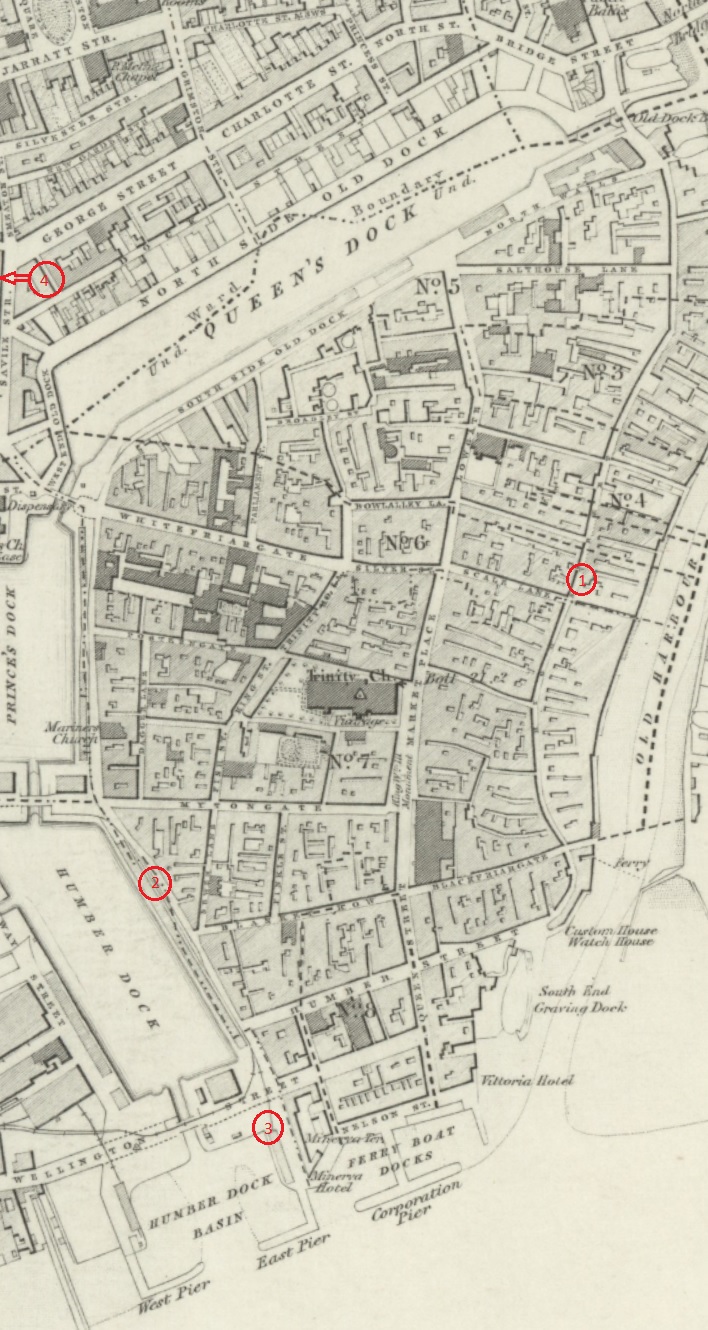
Using the map fragment of Hull at right, which presents detail of a map whose survey was completed in 1853,59 we can see where the Clarksons lived and worked. The map fragment shows the old town of Hull, sandwiched between the Hull River on the right of the map fragment, which is labelled "Old Harbour", and the three basins on the left labelled "Humber Dock", "Prince's Dock", and "Queen's Dock". These three basins were extensions of a moat that existed when Hull was a fortified town.60 The old town is bounded below by the Humber River, which led after a short distance to the North Sea. High Street, where Thomas and John worked, is the north-south, snake-like street immediately to the left of the Hull River, and parallel to it (shown as number 1). Kirkus & Co and later Clarkson & Carter were located on the Humber Dock Walls, which were located along the border of the Humber Dock basin closest to the old town (number 2).
Also from the 1826 directory, Thomas himself lived on the Humber bank,61 somewhere near the river south of the old town (number 3). This area may have been less developed in the 1820s than it was in this 1853 map. By 1827, the birth record of the third child describes Thomas as living in Myton,62 which was the community immediately to the west of the three basins, just off the left side of the map fragment (number 4).
The Clarksons lived and worked in a compact area that was close to where ships berthed, which was appropriate for their lines of work.
The absence of Thomas from the 1828-29 directory, along with the absence of any partnership of which Thomas was a member,63 makes one wonder what he was doing after the dissolution of Smiths & Clarkson. You may find the answer surprising.
Part 2: Christian Fortitude
One of the most surprising things about Thomas's life before he immigrated to Canada is that he did not spend it all living in Britain.
Consider the following notice that appeared in The Hull Advertiser and Exchange Gazette on June 4, 1830, under the heading "Deaths":64
On Friday last, at Hamburg, after a short illness, borne with christian fortitude and resignation, aged 26, Elizabeth, the wife of Mr. Thomas Clarkson, merchant, formerly of this place.
This beautifully written death notice shows this family's strong religious values, and hints at the struggle that the Elizabeth in the notice seems to have waged.
Consistent with this notice, the directories of Hamburg, which were published every year, show a Thomas Clarkson living at Stubbenhuck No. 46 in both 1829 and 1830,65, 66 but not before or after;67, 68 these directories were likely prepared in advance of the year named, so this Thomas lived in Hamburg between late 1828 and the second half of 1830. This Thomas is described as "Kauf.", Kaufmann, which can be translated as "merchant".69
The evidence that this notice is about Elizabeth (Faram) Clarkson and Thomas Clarkson of Toronto is as follows:
- The Thomas and Elizabeth in the notice had the same names as Thomas Clarkson of Toronto and Elizabeth (Faram) Clarkson.
- The Elizabeth in the notice was about the right age. She would have been 19 in 1823, which is consistent with Elizabeth (Faram) Clarkson being a minor (under 21) at the time of her marriage, and consistent with the age of our Thomas, who would have been 28 in 1830.
- The Thomas in the notice had a profession consistent with our Thomas's activities at Smiths & Clarkson, which was described as a firm of merchants, and consistent with Thomas's profession given on the birth registration of their third child.
- Elizabeth (Faram) Clarkson must have died between the birth date of their third child, 1827,70, 71 and Thomas's immigration to Canada, given the lack of any burial record for her in the same location as other family members in the Toronto area.72 I show below that Thomas immigrated in about 1832, so the timing of the notice is in the right range.
- Our Thomas was absent from the 1828-29 directory of Hull.
- Most importantly, a study of the exports of Thomas's brother John show that he exported to Hamburg during exactly the same period that the Thomas in the notice lived in Hamburg, and not before or after.
To see this last point, consider that the Hull newspapers of the time published every single item that was exported, along with the name of the company exporting it, and the destination. Two Hull newspapers of the period are kept by the British Library and are electronically searchable through the British Newspaper Archive, The Hull Advertiser and Exchange Gazette, and The Hull Packet. Each was a weekly paper.
Even though the British Newspaper Archive search function is highly imperfect, after searching both newspapers over the period 1826 to 1832 for the name "Clarkson", and focussing only on entries under the heading "Exports", we can discern a clear pattern in John Clarkson's activities. John was associated not just with Clarkson & Carter, but also with another partnership called Clarkson & Foster, and his own company called Clarkson & Co.73 Most of his exports were undertaken in the name of Clarkson & Co., with a minority under Clarkson & Foster, and the occasional export under his own name, J. Clarkson.74
John's exports began in May 1828, and were made almost exclusively to Antwerp.75 But starting in December 1828, his exports shifted mostly to Hamburg,76 with the balance being made to a range of European cities including Antwerp, Rotterdam, Amsterdam, St. Petersburg, and Copenhagen. These shipments finished at the end October 1830,77 after which John never exported again during the study period. See a full list of the exports identified through the search here.
Thus, John Clarkson's exports to Hamburg coincided exactly with the presence of the Thomas in the notice, which, combined with the other evidence noted above, proves beyond a reasonable doubt that the Thomas in the notice is Thomas Clarkson of Toronto. This conclusion is corroborated below in a discussion of Thomas's entry in the 1842 Census of Canada.
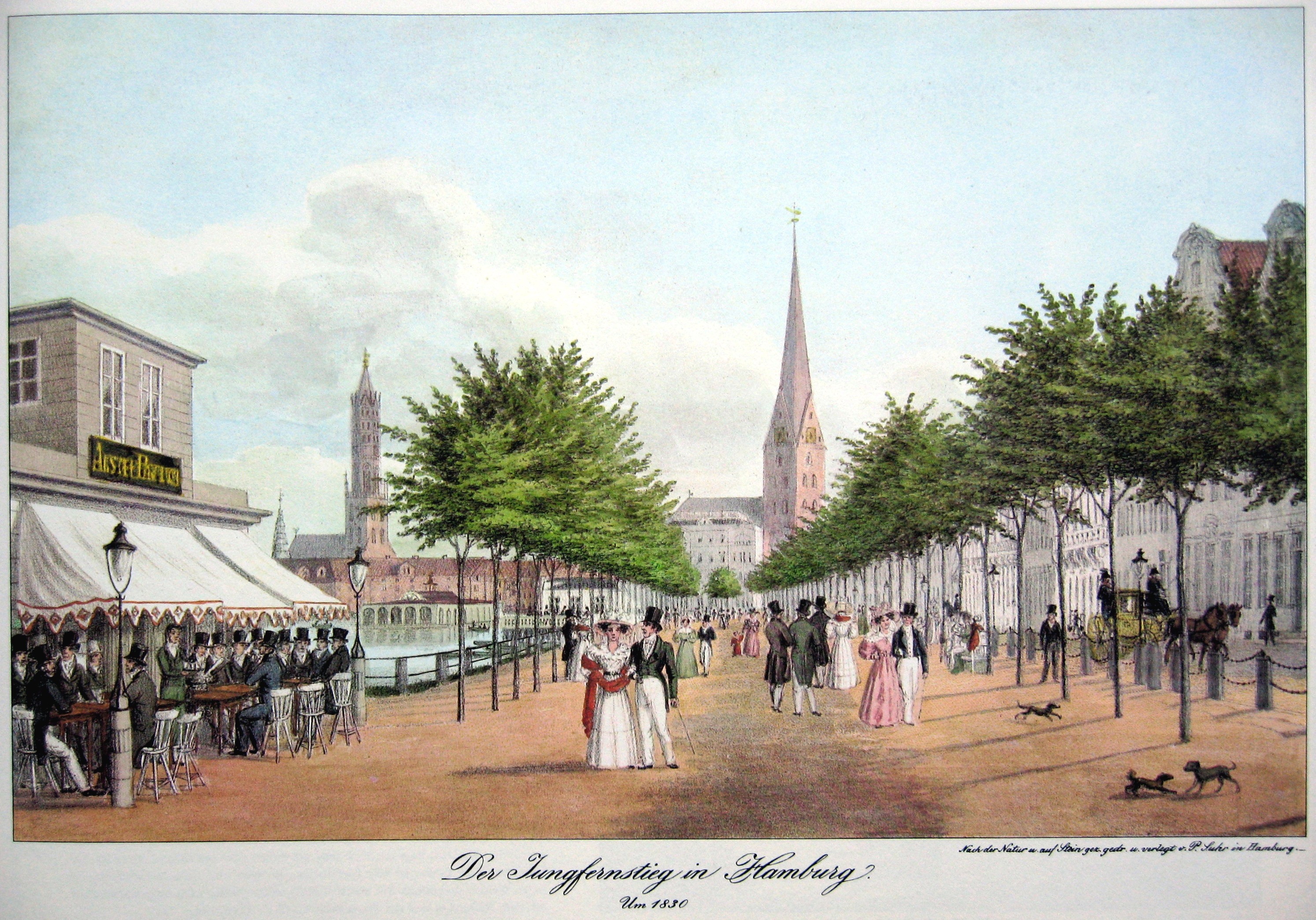
The move to Hamburg was one of many moves Thomas would make in search of opportunity. Hamburg was an important centre for trade in the 1820s an 1830s. It would have been an attractive market to Thomas and John in which to sell the produce of the parts of Yorkshire and Lincolnshire surrounding Hull. Hamburg had become a free city-state in the German federation in 1815 after enduring occupation alternating between Napoleon and Russia.78 As a free state, it had become one of the most important points of European commerce.79 A picture of a seemingly prosperous Hamburg in 1830 is shown above.80
To understand the economics of Thomas's side of the business, the history of the firm Schroders plc is particularly interesting, since Johann Heinrich Schroder was pursuing a similar business at the same time as Thomas. Richard Roberts, in a history of Schroders, describes the following:81
In the first half of the nineteenth century much of the trade in the import of commodities to Europe was conducted on a 'consignment' basis. Merchants in market centres, notably London, Liverpool and Hamburg, received cargoes of produce despatched by planters to merchants in the places of origin. The goods were sold and the proceeds remitted to the shipper or held as a balance on his behalf, depending on the arrangements between the parties, the consignment merchant taking a percentage commission for his services.
Shipping from Hull to Hamburg thus required someone to be on the ground in Hamburg to receive an on-sell the goods. By taking a commission based on selling price, Thomas would have been somewhat insulated against volatile commodity prices, and against price differences between Hull and Hamburg. The following is a sampling of the goods that John exported to Hamburg and for which Thomas must have found buyers:82
- cottons, including cotton twist, cotton yarn, and cotton lace,
- woollens,
- linens,
- white lead,
- brandy,
- one steam engine, complete except boiler,
- one boiler,
- nails, and
- bundles of iron.
Most of John's exports fell in the first three categories.
The timing of Thomas's presence in Hamburg means that he and Elizabeth may have had additional children while there.83 It is quite possible that Elizabeth's death resulted from complications due to child birth.
The export business of John and Thomas came to an end when John was declared bankrupt on November 16, 1830.84 In fact, there had been a sharp decline in shipping from Hull generally during the period 1825 to 1835,85 causing authorities to form a pessimistic view of the Hull economy.86
Could it have been that Elizabeth's death caused Thomas to return to Hull, which in turn led to John's bankruptcy? Or is the more likely scenario that John's bankruptcy occurred for business reasons, and caused Thomas to return to England? It is impossible to distinguish cause and effect from the evidence we have. Regardless, Thomas may well have been involved to some degree in his brother's bankruptcy proceedings and learned lessons that would serve him well much later in life when he started a bankruptcy practice of his own.
In 1832, a cholera epidemic swept through Hull.87 It is against the backdrop of an economic downturn and a cholera epidemic that Thomas decided to move his family to Canada. Though his reasons for moving are not known for certain, economic reasons were likely at the forefront of Thomas's concern. With two young children, having already lost his wife, the cholera epidemic may just have made the decision more urgent.
Part 3: Cold and Stormy—Arrival in Canada
Thomas arrived in Canada in about 1832. He may have made more than one trip at that time, and he may have travelled via New York City.
Thomas's arrival in Canada is referred to in at least three primary sources. First, the 1842 census of the Province of Canada is mostly lost, but the records for the City of Toronto have survived. This 1842 census provides one line for each family, and the name of the head of household is the only name given. Also reported is the number of years in which the family had been in Canada. In that census, Thomas Clarkson is named as a head of household, and he and his family are reported to have been in Canada for 9 years, making the year of their arrival approximately 1832 (considering that the census day was February 1, 1842).88
A second source that provides information on Thomas's arrival is the records of the York Pioneers Association. That society initially had as members only those who had been associated with Toronto before it became a city on March 6, 1834, before which it was called the Town of York. His membership record for the York Pioneers Association shows that Thomas was first involved in the Town of York in 1832.89
A third source for Thomas's arrival in Canada is the passenger manifest of the ship on which he arrived. The manifest of the ship New York on one of its sailings to New York City was registered with the Port of New York City on February 21, 1833. The manifest includes a Thomas Clarkson aged 31 (and thus born in 1801 or early 1802), a merchant bound for Canada.90 Since the name, birth year, occupation, and destination all match, this is likely Thomas Clarkson of Toronto. The Thomas Clarkson aboard the New York was travelling without family members, suggesting that if he is the same Thomas, then either his family travelled on a different ship, or it was not his first arrival.
Thorne Hill—Whiskey by the Gallon
When Thomas first arrived in Canada, he went to live in Thornhill, Ontario. Thornhill was then a village north of Toronto. Thomas's involvement in Thornhill would continue for at least twenty years.
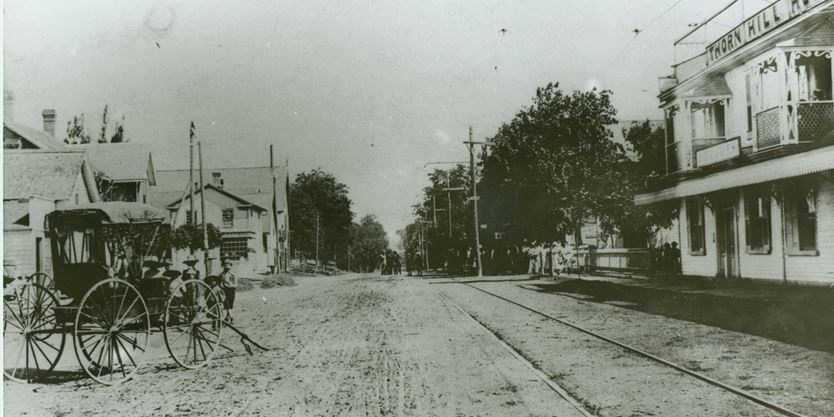
Thornhill's main street is the same as the main street of Toronto, Yonge Street, which is pictured at right c1905.91 The section of Thornhill on the west side of Yonge Street then lay in the Township of Vaughan (today the City of Vaughan), and the section on the east side lay in the Township of Markham (today the City of Markham).
The earliest mention of Thomas in connection to Thornhill is his marriage to Mary Brunskill on March 27, 1834.92 At that time, both bride and groom were unambiguously said to reside in Thornhill. According to family information, the couple had four children together,93 to which I have added three more from the records of a Toronto cemetery94 as confirmed with the records of the Anglican Diocese of Toronto:95
- John Brunskill Clarkson (1835-1904), who became a Wesleyan Methodist minister, an occupation that was not approved of by his Church of England father,
- Louisa Ann Clarkson (1836-1888), who married John Bloor Helliwell and lived in Montreal,
- Mary Intelligence Clarkson (1837-1844), who died of scarlet fever,
- George Munro Clarkson (c1839-1844), who died of scarlet fever,
- Victoria Clarkson (1840-1840),96
- Robert Guy Clarkson (1841-1889), who married Caroline Brown Spencer and lived in Milwaukee, and
- Benjamin Read Clarkson (1843-1897), who married Margaret Maule Isabella Jarvis and lived in Toronto.
Many children in the nineteenth century lived short lives and died sad deaths. But the lives of Mary Intelligence and George Munro need special mention. Mary Intelligence, older by about a year, and George Munro were baptised on the same day,97 thus intertwining their fates from the first. Being close in age, they surely played together in their parents' large house, and perhaps comforted one another when their mother died. Being together so much, when one caught scarlet fever, the other naturally did too. Mary Intelligence, aged 6, and George Munro, aged 5, died within days of each other.98 They were buried on the same day in Potter's Field, then Toronto's only public cemetery, which sat at the corner of Yonge and Bloor Streets.99 But this was not their final resting place—their graves would then be dug up and moved when Potter's Field was closed.100 To compound the indignity, George Munro's name was mixed up with his father's, and he was recorded as being named Thomas in the cemetery records,101 which was highly improbable given that Thomas Jr. lived in the same household. Perhaps the worst indignity was having their very existence forgotten when the family records were assembled in the late 1940s.102 This paragraph will hopefully right that last wrong.
As Thomas's family grew, so did his reputation in business.
In 1835, Thomas was operating in Thornhill as a storekeeper, according to the baptismal record of his son John Brunskill.103 Thomas was also working as a commission merchant, according to the diary of William Helliwell,104 a brewer whose family would become well connected with the Clarksons. The diary's entry for December 17, 1835 shows that William himself visited Thomas in Thornhill. It reads as follows (with the original spelling preserved):
Although this morning was verey cold and stormey I started for Thorne hill Had a verey cold and unpleasant ride.
Commissioned Clarkson to by barley 5 per cent com
Snowed the whole of the day got home at seven
This diary entry shows that Thomas was operating as a commission merchant, following in his experience in Hull and Hamburg, and is consistent with Thornhill: An Ontario Village which lists Thomas as a merchant in early Thornhill.105
The 1837 directory of Toronto gives a number of references to Thomas.106 First, he was listed as an occupant of Concession 1 Lot 31 in the Township of Vaughan. Second, he was also listed as an occupant of Concession 1 Lot 36 in the Township of Vaughan. Both of these locations would be considered to be part of Thornhill and its vicinity. Third, he was listed as a shopkeeper at 55 Yonge Street in Toronto,107 of which more is said below. Each of these three mentions tells a different part of the story.
Thomas's presence in Concession 1 Lot 31 in Vaughan is consistent with Thomas being a storekeeper and merchant. Concession 1 Lot 31 was the location of a number of village residents—the same directory lists five others in this same location. The recent Archaeological Assessment for a subway extension through Thornhill made note of Thomas's residence there, considered transfers of deeds of the property, and suggested Thomas was likely a tenant:108
By 1837, an early Directory for Vaughan showed that this lot contained several resident settlers, although most appeared to have been tenants rather than actual owners. They included: merchant Thomas Clarkson,...
Thomas's mention in Concession 1 Lot 36 is also interesting. Concession 1 lot 36 was north of the centre of Thornhill, and likely agricultural, so it is possible that Thomas was working somehow in an agricultural pursuit, or perhaps that is where he lived.
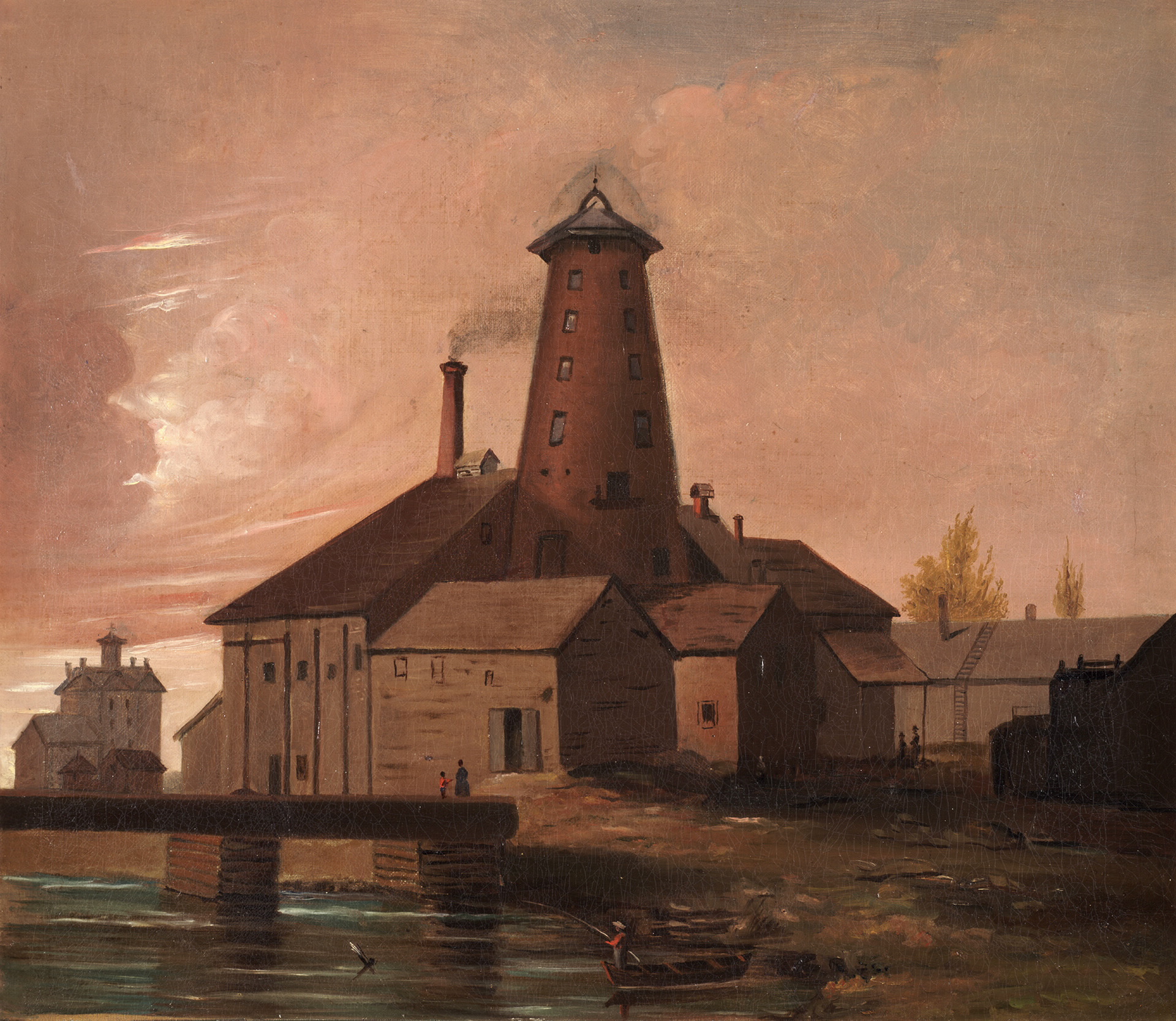 Even though by this time Thomas had started business in Toronto as well, he continued his relationships in Thornhill, particularly with the Brunskill family, which can be seen from an analysis of the accounts of the Gooderham and Worts windmill on the shore of Lake Ontario, pictured at right.109 The analysis contained in the book entitled The Windmill and its Times shows the following purchases of whiskey by Thomas:110
- 1838 - Thomas Clarkson & Co., 55 Yonge St., purchased less than 850 gallons
- 1839 - no accounts described in the book for this year
- 1840 - Thomas Clarkson & Co., 55 Yonge St., purchased 1,960 gallons, of which 850 gallons were the "best" whiskey
- 1841 - no accounts described in the book for this year
- 1842 - Clarkson & Brunskill, Thornhill, purchased 2,082 gallons, even though account only opened in August
- 1843 - Clarkson & Brunskill, Thornhill, purchased 2,000 gallons
From these records, Thomas's partnership with John Brunskill appears to have started in 1842. John Brunskill was Thomas's wife's brother.111 The Windmill and Its Times remarks that Clarkson & Brunskill was one of the largest purchasers of whiskey in both 1842 and 1843, suggesting that their business was going well.
In 1843, Thomas's second wife Mary died,112 five days after the birth of her son Benjamin Read.113 She was buried initially in Potter's Field, but later she was moved to Mount Pleasant Cemetery when Potter's Field was closed.114
A directory of Toronto for 1846-1847 gives two addresses for Clarkson & Brunskill, one on Concession 1 Lot 30 of the township of Markham, and Thomas's former location of Consession 1 Lot 31 of the township of Vaughan. Both of these locations are situated in Thornhill, on opposite sides of Yonge Street.115 So Thomas was still connected to Thornhill in 1847.
The last reference to Thomas in Thornhill that I could find is the following advertisement in the British Colonist, a Toronto newspaper, on December 7, 1852:116
PROPERTY TO SELL OR LET.
TO LET: A SHOP & DWELLING HOUSE, in the Village of Thornhill, offering a most favourable opportunity for a person commencing country business. Possession can be had by the 1st December, and a Lease for a term of years given, if required. Apply to JAMES SHUTER, Thornhill, Or, THOMAS CLARKSON, Toronto. November 9, 1852.
While it is not clear from the advertisement what role Thomas was playing, it would be easy to imagine that he was the current tenant wishing to find a new tenant, with James Shuter possibly being the landlord. Thornhill: An Ontario Village confirms that James Shuter owned a general store on the corner of Yonge and John Streets,117 so he was a merchant, like Thomas. In any case, the advertisement shows a remaining connection of Thomas to Thornhill in 1852.
Part 4: Toronto in the 1830s and 1840s
Thomas's mention at 55 Yonge Street in the 1837 Directory is evidence of his early connection to Toronto. Thomas's move from Thornhill to Toronto happened over the period 1836-1847, and represents another example of Thomas moving to pursue business success. Whatever the opportunities for a merchant in a village like Thornhill, they must surely have been greater in a nearby city like Toronto.
The City of Toronto Archives contains a letter written by Thomas to the Mayor and Corporation of the City of Toronto on July 6, 1836 requesting to rent a location in Market Square (which was then located in the block today occupied by St. Lawrence Hall and the North Market building).118 It reads in part (with its original spelling):
I hereby beg to propose to take from you the Rooms previously occupied by Mr. Bull at the South end of the Market Square for one year and shall be willing to pay Thirty Pounds for the same in such payments as is customary.
I should require the windows repaired and the whole put into tennantable repair.
The City's records include a report from a special committee of City Council struck to consider the request.119 The committee recommended it be accepted. A subsequent advertisement for flour by Thomas in The Royal Standard shows that he had moved into this location by December of that year.120 This is the first advertisement by Thomas I have found in a Toronto newspaper. By the next year, the directory above shows that he had moved out of Market Square.
The baptism records of Thomas and Mary's seven children tell a story of a family living in two places at once:121
- the first was bapitsed in 1835 in Thornhill,
- the second was baptised in 1836 in Thornhill but the family was said to reside in Toronto,
- the third and fourth were baptised in 1839 in Thornhill and the family was said to reside in Thornhill,
- the fifth's 1840 baptism record could not be found,
- the sixth was baptised in 1842 in Toronto, and
- the seventh was baptised in 1843 in Thornhill but the family was said to reside in Toronto.
The indication in Louisa Ann's baptism record, dated September 18, 1836, that the family lived in Toronto122 suggests the move to Toronto was at least well under way by this date.
1842 Census
We can consolidate our knowledge of Thomas's family by looking at his household's entry in the 1842 census of the Province of Canada. Despite his continuing connection to Thornhill, the 1842 census shows that Thomas lived in Toronto at that time.123 The census contains plenty of information, though it is not easy to decipher—unfortunately, the census listed households, not individuals.
Thomas and his family lived on Palace Street, which is now part of Front Street East, in a house they rented from Christopher Widmer. Thomas was also listed as the proprietor of a house on King Street that was vacant at the time of the census,124 but which we know to be his place of business.125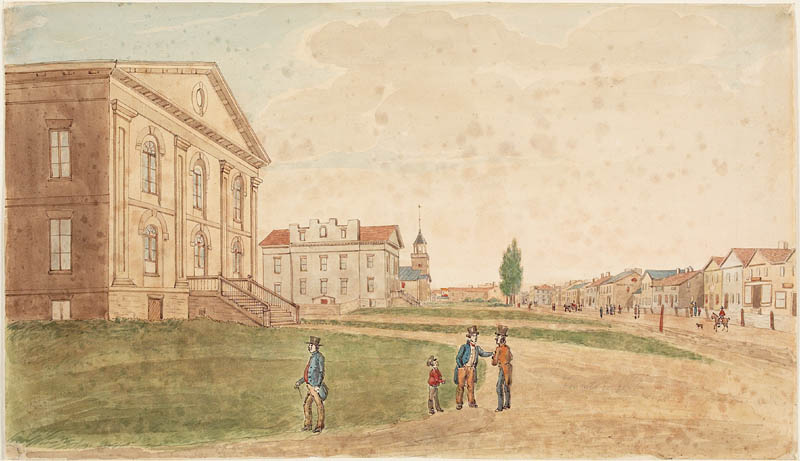 (King Street in 1829 is shown at left.126) The household consisted of ten immediate family members, two female servants, and one male servant. These thirteen people were further classified as follows: three children five and under (two boys and one girl), which should be Mary Intelligence, George Munro, and Robert Guy; three children between 6 and 13 (two boys and one girl), which should be Thomas Jr., John Brunskill and Louisa Ann; one single male between 21 and 29, who is either the male servant or a more distant Clarkson or Brunskill family member—below, I speculate that this family member may have been Thomas Brunskill; one married male between 30 and 59, who is Thomas himself; one single male between 30 and 59, who is either the male servant or a more distant family member; two married females between 14 and 44, including Thomas's wife Mary and a female servant; and two single females between 14 and 44, who would be Betsy Faram and a female servant. Eleven of these thirteen people were members of the Church of England, one belonged to the Church of Scotland, and one was a British Wesleyan Methodist.
Of the thirteen members of the household, five were born in England (at least four of which were family members), five in Canada (all of which were family members), one in Scotland, one in Ireland, and one in Continental Europe. Initially, I had assumed that the Scottish, Irish, and European members were the three servants. However, the census taker for this part of Toronto had supplied additional information: whenever there were some household members who had been born in Continental Europe, he had written the country of origin in very small letters over the number of household members in that column. For example, for another household on the same page as Thomas's, the census taker had put a "1" in the Continental Europe column, and clearly written "Spain" above it. In the row for Thomas's household, the word written above the "1" in that column first appears indistinct. Upon magnification, however, it becomes clear that the word is "Hamburgh".
This information suggests that Thomas Jr. was born in Hamburg. Of course it is still possible that one of the servants was from Hamburg instead, but then I would have expected that person to have belonged to the Lutheran church, by far the predominant denomination in Hamburg,127 or else the Jewish or Roman Catholic faiths. Not only were there were no Lutherans, Jews or Roman Catholics in Thomas's household, but all thirteen people in fact belonged to British denominations.128 Furthermore, note that if Thomas Jr. had been the child born in Hull, he would have been 14 and half years old by the time of the census, but as shown above, no boy in the family was reported to be older than 13. It is therefore certain beyond a reasonable doubt that Thomas Jr. was born later, in Hamburg, and was the fourth or later child of Thomas Clarkson and Elizabeth Faram. Thus I must add one child to the previous list of children:
- Thomas Clarkson (c1829-after 1861) ("Thomas Jr.")
One of the thirteen was described as an alien not naturalized, likely Thomas Jr.129
Blackjack?
On May 2, 1844, Thomas married Sarah Helliwell,130 the oldest child of Thomas Helliwell Jr. and Mary Willson.131 Thomas and Sarah would go on to have ten known children:132
- Henry James Clarkson (1845-1852),133 who tragically drowned in the Don River,
- Mary Adelaide Clarkson (1847-1897), who lived in Toronto,
- Alice Sarah Clarkson (1849-1849),
- Alice Elizabeth Clarkson (1850-1939), who married Harold Lambe and lived in Hamilton, Ontario,
- Edward Roper Curzon Clarkson (1852-1931), known as E.R.C., who married Amy Lambe and lived in Toronto,
- Arthur Swinburn Clarkson (1854-1855),
- George Helliwell Clarkson (1856-1933), who married Fanny Gertrude Lambe and lived in Toronto,
- Annie Helena Clarkson (1858-1862),134
- Alexander Mitchell Clarkson (1860-1934), who lived in Toronto, and
- Ethel Alberta Clarkson (1863-1943), who lived in Toronto.
In total, then, Thomas had at least 21 children. The timeline, particularly with respect to his first wife, leaves room for more.
Household Goods by the Shipful
Building on the experience he gained in Hull and Hamburg, Thomas came to play a major role in the business life of Toronto. Consider the following advertisements placed by Thomas in one Toronto newspaper, which were typical of his daily advertisements in a number of papers. In the Toronto Herald of March 6, 1845, two advertisements by Thomas appeared under the heading "Auction Sales". The first focussed on clothing, and read as follows:135
By T. CLARKSON & Co.
EXTENSIVE SALE OF SEASONABLE DRY GOODS.
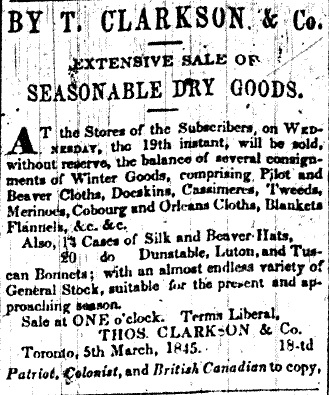
At the Stores of the Subscribers, on WEDNESDAY, the 19th instant, will be sold, without reserve, the balance of several consignments of Winter Goods, comprising Pilot and Beaver Cloths, Doeskins, Cassimeres, Tweeds, Merinoes, Cobourg and Orleans Cloths, Blankets, Flannels, &c. &c.
Also, 17 Cases of Silk and Beaver Hats,
20 do Dunstable, Luton and Tuscan Bonnets; with an almost endless variety of General Stock, sutiable for the present and approaching season.
Sale at ONE o'clock. Terms Liberal,
THOS. CLARKSON & Co.
Toronto, 5th March, 1845.
Patriot, Colonist, and British Canadian to copy.
The fact that Thomas did not even list the street on which he was located is evidence that the general public was well acquainted with his auctions. Thomas didn't stop at dry goods; he also dealt in perishables. His second advertisement read as follows:136
By T. CLARKSON & Co.
Sugars, Wines, Rice, Coffee, Teas, &c. &c. &c., BY AUCTION
AT the STORES of the Subscribers, on WEDNESDAY the 12th instant:
- 15 hogsheads Muscorado Sugar,
- 10 barrels Rice,
- 10 barrels Currants,
- 20 bags Laguyra Coffee,
- 20 barrels Roasted Coffee,
- 6 boxes Sperm Candles,
- 50 boxes Liverpool Soap,
- 50 boxes Canada Soap,
- 50 boxes Raisins,
- 4 bags Cloves
- 20 barrels No. 1, Herrings,
- 50 barrels Whiskey,
- 20 hogsheads best Brandy,
- 6 hogsheads Hollands Gin,
- 5 quarter-casks Brown Sherry,
- 10 quarter-casks Port,
- 10 quarter-casks Madeira,
- 10 boxes Cavendish Tobacco,
- 2 casks Alum,
- 150 kegs White Paint,
- 10 boxes 12 x 14 and 12 x 16 Glass,
- 10 kegs Putty,
- 6 casks Whiting,
- 100 reams Wrapping Paper,
- 10 boxes Saleratus,
- 10 kegs Wrought Nails,
- 6 casks patent English Cut Nails,
- 10 cwt. Sad Irons,
- 5 tons Bake Pans and Bellied Pots,
- 8 dozen Plough Strings,
- 2 tons Sugar Kettles,
- 1 ton Shot, and
- 20 kegs Sporting Gunpowder.
With a quantity of other Goods.
Sale at ONE o'clock.—Terms as usual.
THOS. CLARKSON & Co.
Toronto, March 3, 1845.
The Colonist and Patriot to copy.
Thomas's "usual" liberal terms meant giving a combination of three and six months to pay, depending on the amount owed, in exchange for "approved" notes.137
Through frequent newspaper advertisements, Thomas Clarkson became a household name. Many residents of Toronto and the surrounding towns and villages would have recognized his name and patronized his place of business.
Margaret Atwood refers to Thomas in her historical novel Alias Grace.138 In it, the main character Grace Marks first meets Nancy Montgomery, a housekeeper from Richmond Hill and Grace's future boss, in Toronto while the latter was running errands:
I was there only a short time before I made the acquaintance of Nancy Montgomery, who came to visit, having grown up in the country with Mrs. Watson's cook Sally. Nancy was in Toronto to make some purchases at a dry-goods auction down at Clarkson's stores; she showed us some very pretty crimson silk which she'd bought for a winter dress, and I wondered what a housekeeper would be wanting with a dress like that; and some fine gloves, and an Irish linen tablecloth on behalf of her employer.
While the story is fictional, the representation of Thomas's stores as a place people would go to buy fabric is historically accurate.
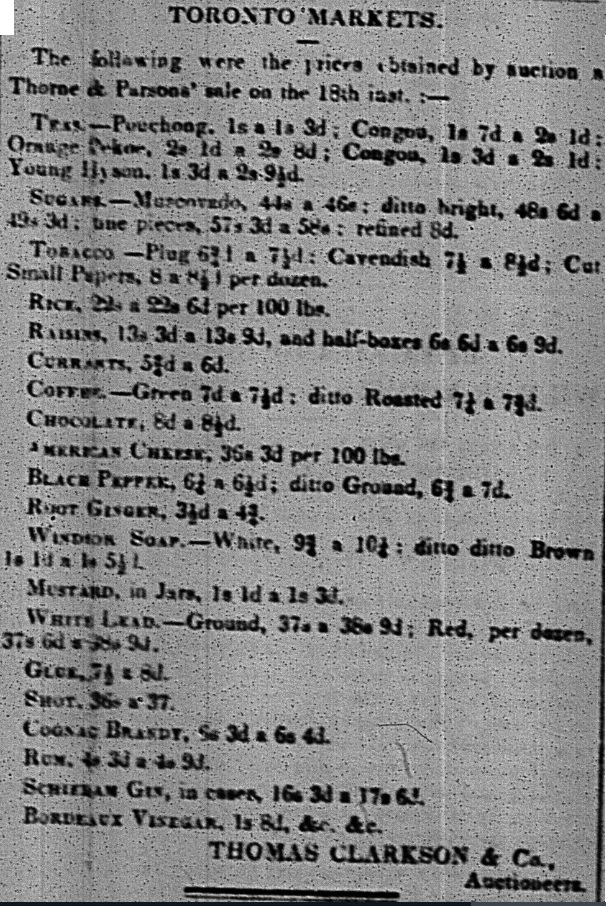 Thomas's active auction business led to side work. Much in the same way that today, stock and commodity exchanges produce a steady flow of data on prices, Thomas became an expert on the current prices of commonly-purchased foods by frequently auctioning perishable goods. For example, The Globe, in its first year of operation, 1844, turned to Thomas for a summary of prices to publish. A sample from October 2 of that year is shown at right.139
Just as Thomas was trained by entering into partnerships with more experienced merchants in Hull, Thomas also trained others in the same way. Most notably, he ran his Toronto business with Thomas Brunskill for a time. Thomas Brunskill, who was in his twenties at the time, was the brother of John Brunskill and Mary Brunskill, who are mentioned above. 140 This much is clear from the following notice, which appeared in The Globe newspaper on February 18, 1845:141
DISSOLUION OF PARTNERSHIP
THE Business carried on in Toronto by the Subscribers under the Firm of THOMAS CLARKSON & CO., as Commission and General Merchants, is this day Dissolved, by mutual consent. All Accounts and Liabilities due to and by the concern will be settled by Mr. THOMAS CLARKSON.
THOS. CLARKSON.
THOS. BRUNSKILL.
Toronto, 1st January, 1845.
In fact, the record of the case Thomas Clarkson and Thomas Brunskill v. William Noble makes clear that Thomas had a partnership with John Brunskill "in the country" (i.e., in Thornhill) while carrying on a partnership with Thomas Brunskill "in the city".142 So during the 1840s, Thomas was engaged in partnerships in both places.
The Clarkson family's relationship to Thomas Brunskill may have been closer than even this case indicates. Thomas Brunskill may well have been the unidentified family member in Thomas's household in the 1842 Census described above. That person was single and born in England,143 and Thomas Brunskill satisfied both criteria in 1842.144 He was a sponsor at the christening of Thomas's son Robert Guy in Toronto in 1841,145 and we know from the court case outlined above that Thomas partnered with Thomas Brunskill in Toronto at least from 1843 to 1845,146 so Thomas Brunskill would have lived in Toronto during that period, and quite possibly in 1842 as well. Thomas Brunskill was not listed separately in the Toronto directories until 1846.147, 148 Since there was no family headed by a Brunskill in Toronto in the 1842 Census,149 it stands to reason that Thomas Brunskill may have been living with the Clarkson family at that time.150
Thomas was lucky in his choice of locations. The 1846-1847 directory of Toronto lists Thomas Clarkson & Co. at 95 King St. East.151 This building was located at King and New Streets (now King and Jarvis),152 likely on the north-west corner, across from the old market.153 Thomas then moved his offices one block south to Front Street East at the base of Helliwell's Wharf, where he continued his business throughout the 1850s.154 The timing of this move is confirmed by a notice dated April 29, 1848 to let a four-storey brick building then being occupied by T. Clarkson & Co.155 Thomas was fortunate that he left the King St. building when he did—it was destroyed the next year in the Great Fire of 1849, which also destroyed the old market and St. James Cathedral,156 while Thomas's new location by Helliwell's Wharf was not affected by the fire.
Helliwell's Wharf was owned by his father-in-law, Thomas Helliwell.157 At this new location, Thomas was able to use the wharf to bring merchandise directly to his place of business, profiting both him and his father-in-law. 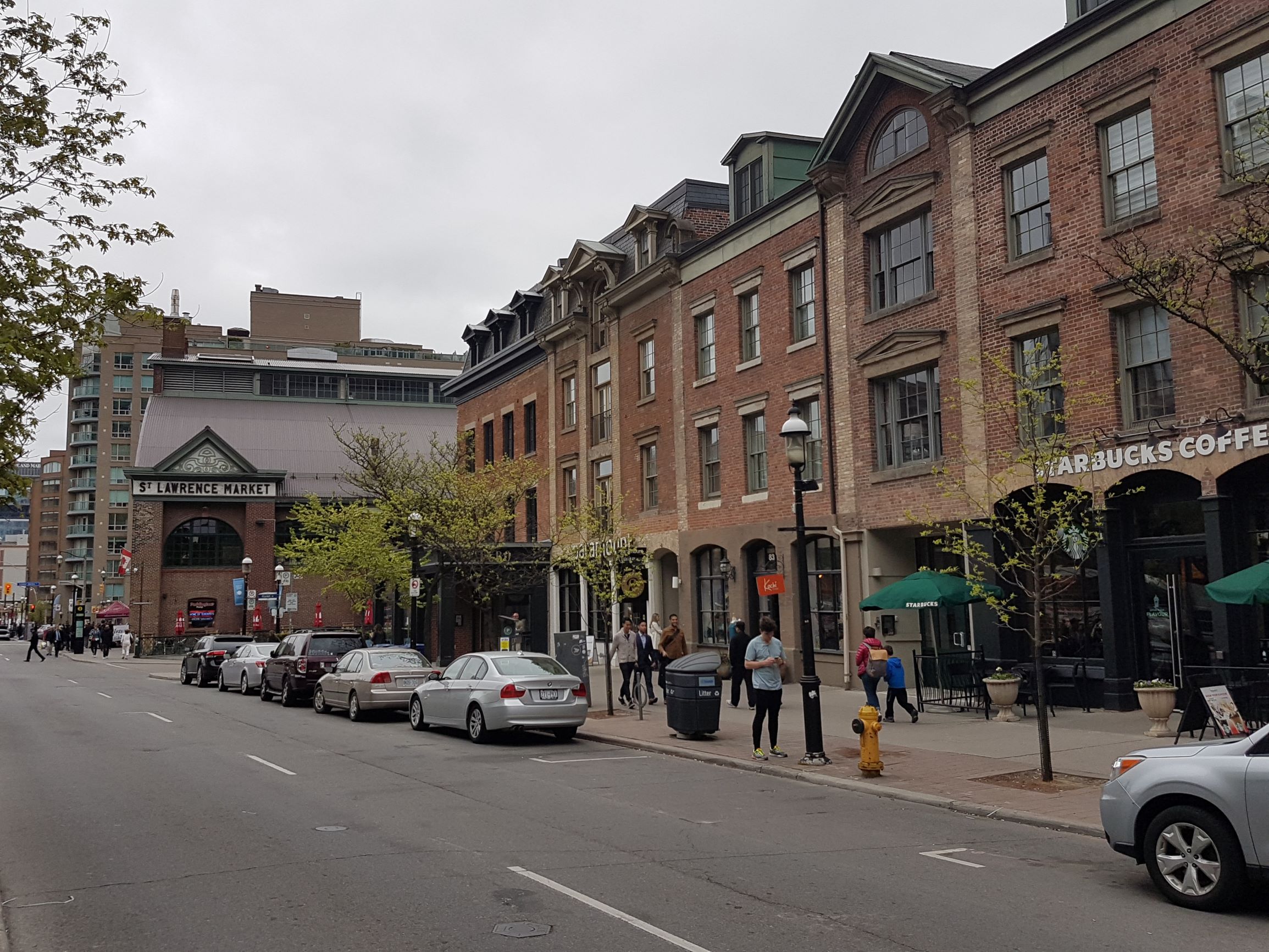 Thomas's office was two doors away from the new market building that had opened in 1844. Thomas's office is pictured in the photograph at right, on the far side of the Starbucks, where it still stands today at 83 Front St. East, with St. Lawrence Market in the background.158 It is also shown in front of the new market at the top of this page, a portion of a photograph taken in 1876.159
The same directory confirms Thomas's residence was situated on Palace Street in Toronto,160 which today is the eastern part of Front Street. His house was located near the gas works close to Princess St.161
It was around this time that Thomas began joining with other merchants in the city to discuss and lobby for reforms that would benefit the commerce of the city. Some of these merchants, including Thomas, founded the Toronto Board of Trade in 1845 to help the group exercise political influence. Thomas seems to have been most active in issues that would affect Toronto's business interests.162
Founding Member of the Toronto Board of Trade
The threats to business were significant in those days: tariffs levied by the United States, statutory limitations on interest rates that businesses and individuals could charge (called "usury laws"), and a lack of infrastructure to transport goods, among others.163 These issues caused a number of merchants, including Thomas, to band together to discuss such topics and exert influence over the legislative process.
In 1845, the Parliament of the united Province of Canada passed an Act to incorporate the Toronto Board of Trade. The Act read, in part, as follows: (with emphasis added)164
Anno Octavo Victoriae Regina
Cap. XXIV. An Act to incorporate the Board of Trade of the City of Toronto [10th February, 1845.]
Whereas George Perceval Ridout, Thomas Clarkson, Peter Paterson, John Mulholland, William Ledley Perrin, and others hereinafter named, Merchants, resident and carrying on trade in the City of Toronto, have, by their Petition to the Legislature, represented that they have associated themselves together for some time past for the purpose of promoting such measures as they might, upon due consideration, deem calculated to advance and render prosperous the lawful trade and commerce of this Province, and of the said City of Toronto more especially, and have further represented, that having already experienced the good effects of their said Association, and being convinced that the advantages arising from it would be greatly extended and increased if they and their associates and successors were incorporated, and if certain powers were conferred on them, they pray the Legislature so to incorporate them and grant them such powers; ...
Thomas's prominent mention in the Act may be evidence of his familiar name in the business community, even at that time. The Board of Trade was destined to become an influential part of Toronto society, and Thomas would significantly increase his influence over politics and economics through being involved with the Board of Trade.
One topic the Board of Trade would take on in the 1850s was reciprocity—free trade—with the United States.165 The Board of Trade was squarely in favour of it. In 1849, Thomas made a speech on reciprocity at a well-attended special public meeting on or about February 20. We are fortunate that The Globe chose to reprint the speeches from that day verbatim. The following are the first few sentences of his speech:166
As I have never been accustomed to deliver my sentiments on the avarious subjects which have become matters of public discussion, I feel considerable diffidence in addressing this meeting, and that I may not be confused or embarrassed in what I have to say, I have adopted the sole course of writing down the leading features of my speech. It is perhaps only right, Mr. Chairman, that I should apologize to the gentlemen who have taken so active a part in calling this meeting together, for wishing to occupy any of your time in the declaration of sentiments, facts and opinions, which I am convinced, from the tenor and spirit of the resolutions you have just read, are at variance with those entertained by a great many present. But believing that we have all one object in view, and that controversy can never be disadvantageous to the interests of truth, I take the liberty of addressing you on the subject of this day's discussion. The great question at issue, then, is, if I understand it right, which I admit I did not do until I heard the resolutions read, is, whether it is for the real interest of Canada (I mean Canada West) to make laws for the protection of her own manufacturing industry, by the imposition of what are generally termed protecting duties? To this question I answer that I do not think it is for the interest of Canada, or any other country, to protect particular interests...
Thomas went on to argue that it was counter to everyone's interests to urge the British government to raise preferential tariffs while the Province of Canada was negotiating a reciprocity agreement with the United States. You can read the entire speech here. That Thomas was willing to stand up to a very large audience is to his credit. Yet the start of this speech is astounding—Thomas was such an accomplished businessman and auctioneer, but he was clearly not comfortable speaking in public. This much is clear from the several sentences in which he downplays his own views and discusses his preparation. Nevertheless, his willingness to state his position despite opposition would serve him well in the 1850s and beyond.
Part 5: Zealous and Efficient—Toronto in the 1850s
Thomas was a natural salesman—he would buy and sell almost anything. Ships would come into the Toronto harbour and he would auction portions of their contents, as indicated in the auction advertisements above. But he would also buy and sell shipments of items on a one-off basis, and in the 1850s he would place advertisements in the Toronto newspapers for single batches of items. Consider the extreme example of The Globe on August 1, 1850. On a single page, Thomas had ten advertisements running, including eight "for sale" advertisements offering the following:167
- 3,000 pairs of boots and shoes
- 100 packages of tumblers and glass-ware
- 100 packages of dry goods (in this case, fabrics)
- 50 tons Welsh slates
- 20 barrels of Labrador herring
- 20 barrels of bath bricks
- 30 barrels of London porter
- Sugar, mackerel and herrings
The same newspaper page listed "wanted" advertisements by Thomas for the following:
- 500 kegs of butter
- 50 tons scrap iron
The "wanted" advertisements show Thomas was both procuring and selling goods at this time.
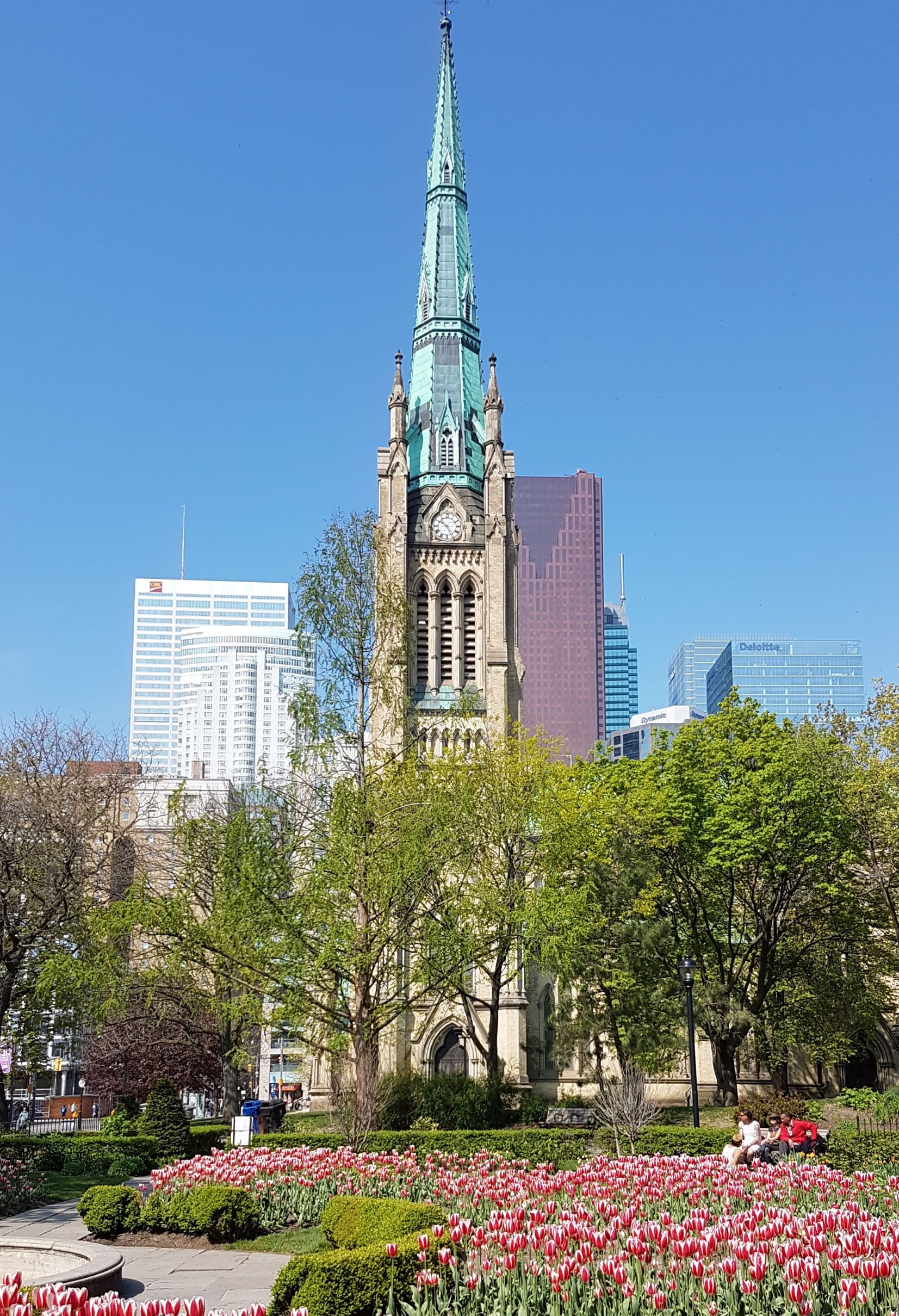 Thomas's positions on business issues were informed by his religious and political leanings. Thomas was a regular churchgoer, attending the Church of England St. James' Cathedral on King Street, pictured at left,168 the traditional place of worship of the ruling class in Toronto and Upper Canada.169 After the cathedral was rebuilt following the 1849 fire, Thomas purchased a pew for his growing family, and traded up when the need arose. For example, the Pew records of St. James' show that in 1853, Thomas purchased pew number 84 on the centre aisle from Thomas Milburn, and in 1856, he sold the same pew to James Armstrong.170 (In the years immediately after the 1849 fire, during the reconstruction of the cathedral, Thomas's family held baptisms in Little Trinity Church on King St. E.—both Alice Elizabeth and E.R.C. were baptised there.171) In addition to providing a place to worship, Thomas' membership in the cathedral parish provided important connections to powerful religious, political and business leaders.
Thomas was conservative in his politics, consistent with his being a business owner and adherent of the Church of England. To see this, note that on September 28, 1855, news reached Toronto of the withdrawal of the Tsar of Russia and Russian forces from Sevastopol, after a year-long siege of that city by British and French forces.172 This was viewed as a great victory for the British Empire—public celebrations were held in Toronto on October 5 that included an assembly to congratulate the Queen,173 in which Thomas participated.174 Subsequently, George Brown's The Globe, a Reform (i.e., liberal) newspaper, made the following complaint (with emphasis added):175
The meeting held on Friday last, in St. Lawrence Hall, was a very proper one. It was fitting, when we were rejoicing over a national triumph, that we should address the Sovereign, who is to us the representative of the whole British empire of which we form a part. We have nothing to say against the meeting, nor against the sentiments uttered by the speakers. We do think we have reason to complain, however, that the gentlemen selected to represent their fellow citizens on that occasion were all taken from one political party. It does appear to us to smack of Toryism and Compactism to choose Mr. Chief Justice Robinson, Mr. Lewis Moffatt, Mr. John Hillyard Cameron, Mr. J. H. Hagarty and Mr. Thomas Clarkson to figure on the occasion, and not to suffer a single man who ever uttered a liberal sentiment to open his mouth.
In The Globe's view at least, Thomas's ideas and allegiances were squarely conservative.
Yet Thomas's brand conservatism was a pragmatic one. He did not hesitate to cooperate with people who held political perspectives that were different from his own. For example, Thomas joined Allan Macdonnell, William McMaster, and Adam Wilson, all prominent Reformers, to agitate for a private railway from Canada West into the Hudson Bay Company lands.176 They were ultimately successful in securing a charter for the North-West Transportation, Navigation and Railway Company in 1858.
Thomas was responsible for starting and growing many businesses and organizations in Toronto. For example, in the 1856 directory of Toronto, he is listed as an executive with the Toronto Exchange, a commodity marketplace,177 as well as a board member of the Beacon Fire and Life Insurance Co.,178 and a board member of the Unity Fire Association.179 In each of these appointments, he interacted with people who held real political power. For example, John A. MacDonald was a trustee of the Beacon Fire and Life Co., and Alan McNabb and George Brown were fellow directors of the Unity Fire Association.
Of the institutions in which Thomas was involved, at least five have endured to the present and now form important parts of Canadian society. Today those institutions are called the Toronto Region Board of Trade, the Toronto-Dominion Bank, Ernst and Young LLP in Canada, Ports Toronto, and the Toronto General Hospital. Of these, Thomas's membership in the Toronto Board of Trade was the key to opening doors to the others. Thomas was a founding member of that institution, and the early members' connectedness meant that Thomas and the Board of Trade exercised considerable influence over many other early Toronto institutions.
President of the Toronto Board of Trade
In 1852, Thomas was elected the second president of the Toronto Board of Trade.180 The Globe, in reporting Thomas's election, called him "a staunch Free Trader, and an amiable man".181 His election would prove to be a further escalation of his power and influence.
The Toronto Board of Trade, like Toronto's business class, was dominated by merchants.182 Among its early successes was the encouragement of railroads to be built.183 The board also argued for lower tariffs between Canada and the U.S.184 But the Board of Trade was not always successful in getting what it wanted. A Georgian Bay Canal was much discussed in the period of Thomas's presidency, championed by Thomas, and endorsed by the board, but never ultimately acted upon.185 Douglas McCalla, in a paper entitled "The Commercial Politics of the Toronto Board of Trade, 1850-1860", summarized the Board of Trade's views as follows:186
Most of its opinions then fall into one or more of three categories. First, it favoured "development" of all sorts. Second, it sought freer trade, an end to various restrictions and burdens which were seen to exist. Third, it desired greater ordering and structuring of trade, in the interests of clarity and security. These objectives were not closely and precisely defined; they were not always logically reconcilable; they were often not even achievable. Above all, the board desired further development, and it supported all projects which it thought would add to Toronto's hinterland and tighten its control over it. It welcomed government involvement in the achievement of these ends but preferred local control over such projects.
Thomas brought a high degree of focus to the job. When he was nominated in absentia for re-election in 1854, he was described as "zealous and efficient", and that he had "assiduity", meaning he kept close attention to what he was doing.187
Through founding and successfully presiding over the Board of Trade during its early years, Thomas had a significant and lasting impact on Toronto society.
Thomas's position as President led to him being considered for other boards. He sat on the boards of the Bank of Toronto, a number of insurance companies, the Harbour Trust, and the Toronto General Hospital.
The Bank of Toronto
In 1856, Thomas became a founding board member of the Bank of Toronto, a Toronto-based bank that later merged, in 1955, with the Dominion Bank of Canada to become the Toronto-Dominion Bank ("TD").188 TD is one of the six largest Canadian banks that control about 90% of the banking assets in Canada.189 As of early 2019, TD was the second largest bank by assets in Canada.190 At the same time, TD was the eighth largest bank in the United States by assets.191
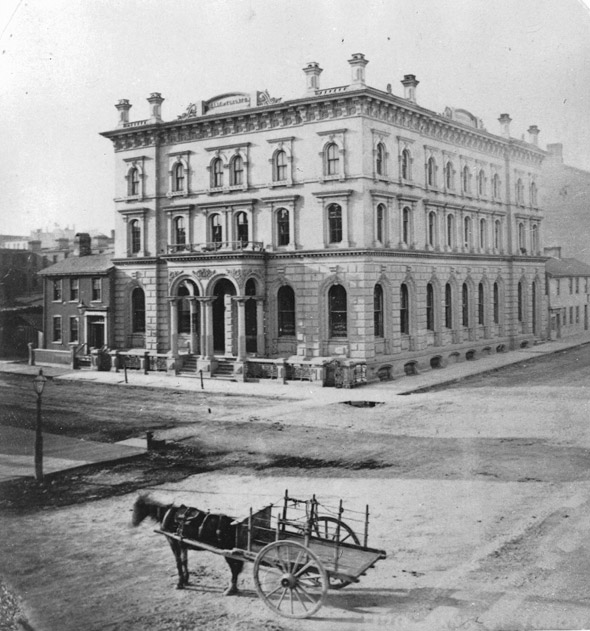
The Bank of Toronto was founded by a group of grain millers, merchants and farmers, who saw the need for rural areas to be better served by a bank.192 (The headquarters of the Bank of Toronto in 1868 is pictured at right.193) Banks rise and fall on their reputations, and the Bank of Toronto needed board members with established credibility. Thomas was a grain dealer himself, and was well-known and well-respected in the city. In the words of Joseph Schull, writing about the Bank of Toronto,194
Meanwhile successful efforts had been made to acquire technical and financial wisdom for the higher echelons. Thomas Clarkson, who was then president of the Commercial Building and Investment Society and a prominent Toronto financier, appeared at the first formal meeting of the board of directors on July 1, 1856...
This not only tells us that Thomas filled an important need for the Bank of Toronto, but also speaks to Thomas's stature in Toronto society.
At the first Annual General Meeting of the bank, Thomas opened the meeting by nominating the chair.195 The next day, he was elected Vice-President of the board.196 He helped the Bank of Toronto get a strong and reputable start, which it would need as the economy turned down at the close of the 1850s.197
The Harbour Trust
Thomas was a founding trustee of the Commissioners of the Harbour of Toronto, which was commonly known as the Harbour Trust.198 The Harbour Trust was founded in 1850, and was a predecessor of the Toronto Harbour Commission, the Toronto Port Authority, and finally Ports Toronto.199 The Harbour Trust was an important step in the development and protection of the harbour. Michael Moir described the creation of the Harbour Trust as follows:200
The first permanent body responsible for the maintenance of the bay was the Commissioners of the Harbour of Toronto (more commonly known as the harbour trust) that was established in 1850 after a prolonged campaign led by the Toronto Board of Trade. Under the terms of its acts of incorporation, the harbour trust was charged with the preparation of plans and estimates for the improvement of the harbour, the management of any works undertaken, and the regulation of vessels plying the waters of Toronto Bay.
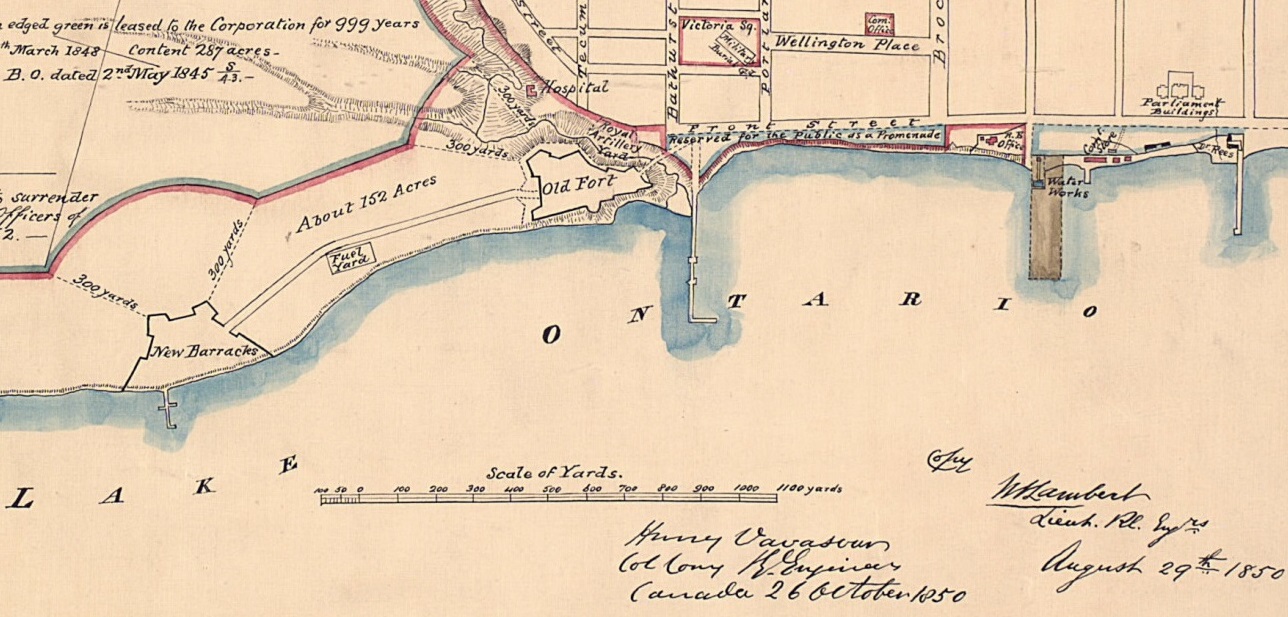
It was natural that Thomas was involved in regulating the harbour, since so much of his life revolved around it, given that he was an importer and merchant who relied on the harbour for his livelihood, his business backed on to the harbour through most of his time in Toronto, and his residence was located very close to the harbour. A partial map of the harbour in 1850 is shown below left.201
In 1850, the commissioners passed a set of rules for the harbour, which were published in 1852 as Rules, By-laws, and Regulations, of the Port of Toronto.202 This document set out the rules of the port, covering such topics as declaring cargoes, removing sunken ships and sunken wharves, watching over cooking fires onboard ships, the protocol for passing other ships, and avoiding obstructing the harbour master.
One of the main issues that the Harbour Trust had to deal with in the early 1850s was the fact that the entrance to the harbour was being gradually closed by natural forces.203 Wind and water currents were taking sand from the Scarborough Bluffs and depositing it on parts of the peninsula forming the harbour, and simultaneously eroding other parts.204 The entrance to the harbour (today called the "Western Channel") had shrunk from 439 metres in 1796 to only 110 metres by 1850.205 Dredging was the temporary solution implemented by the commissioners while a permanent solution was sought. This search would end up taking decades, and outlast Thomas's tenure on the Trust.206
The Toronto General Hospital
The Toronto General Hospital is part of the University Health Network, and one of six hospitals located within a four-block area close to the University of Toronto and the Ontario Ministry of Health. It helps form the backbone of the health system in Ontario.
As the result of his position as the President of the Toronto Board of Trade, Thomas sat on the board of the Toronto General Hospital early in its life.207 Founded in 1829 as the York General Hospital, the hospital was still young when it became managed by a hospital trust in 1847.208 Based on directories and newspapers of the time, Thomas appears to have sat on the the board from 1852 to 1856,209, 210, 211, 212 and was elected to sit again on the board in 1859.213, 214, 215
With Thomas on the board, the decision was made to move from cramped quarters at King and John Streets to more spacious quarters at Gerrard Street East between Sackville and Sumach.216 This decision proved controversial, as the new location was thought by some to be too far away from the centre of the city, though today that location would be considered very central. At the time, the Upper Canada Journal of Medical, Surgical and Physical Science wrote,217
Only picture to yourself the necessity of conveying in the middle of winter, perhaps upon a shutter, any poor man who may chance to meet with a serious accident at the western end, a distance of four or five miles, before he could be received into hospital.
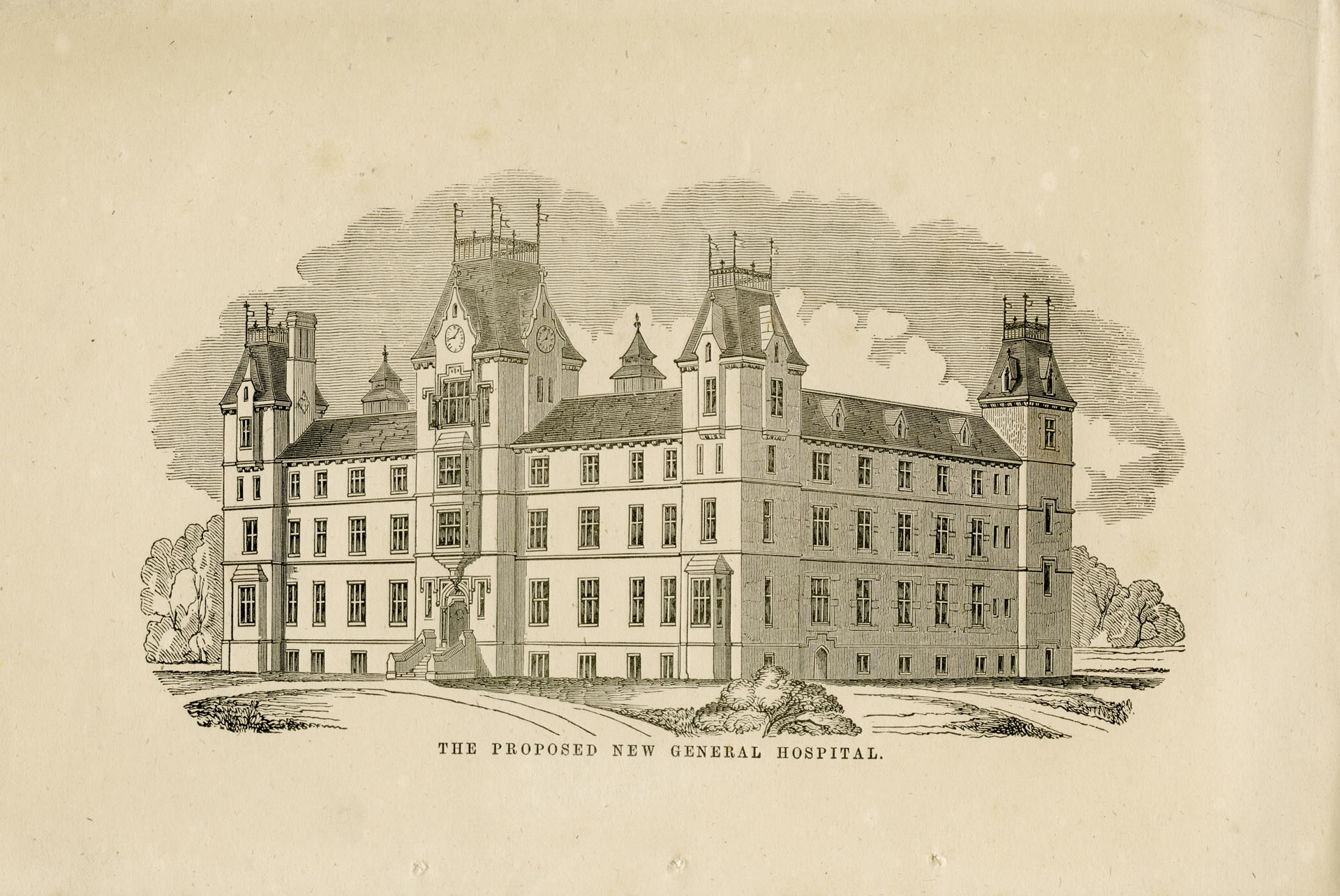 But the debate about location died down, the hospital opened, and it seemingly proved acceptable. The planned hospital is pictured at right.218 It had 18 wards, 400 beds, and such progressive features as a maternity ward and an operating theatre with a viewing gallery.
According to The Globe in December 1856,219
The style is old English, partially modified. The most novel and original features in the edifice are the roofed towers. These give a singular boldness of character and outline to the entire structure, which is simple and free from extraneous detail, but grouped into a remarkably pleasing composition.
During this period, the dismissal of two doctors came under significant scrutiny.220 It had been accomplished by a 3 to 2 vote of the board, with Thomas voting in favour. One of the controversial aspects of the decision was that the board had split 2 to 2 in person, and the fifth board member had cast his deciding vote by telegram. The Canadian legislature investigated221 but did not change the decision.222 Accusations were made by The Globe, a Reform newspaper, that political and religious preferences of the board for doctors from the Tory- and Church of England-linked Trinity College medical school led them to dismiss the doctors, who had attended the other local medical school, the Reform-linked Toronto School of Medicine.223, 224 This episode underlines Thomas's association with the Tory party and the Church of England.
While many issues came before the board during Thomas's tenure, the decision to move, the design of the new hospital, the purchase of new equipment, and associated questions must have taken much of the board's time during those years.
Allowed to expand and thrive, the Toronto General Hospital went on to pioneer the use of insulin to treat diabetes, and the practice of single- and double-lung transplants during the twentieth century.225
Social Views
Thomas took an active part in furthering social goals that were informed by his religious beliefs, such as temperance.
Thomas believed strongly that mandatory temperance was the right way to combat drunkenness. Thomas was involved in the temperance movement, both by participating in ad hoc meetings and committees of concerned citizens226 and by taking a senior role in an organization called the Friends of the Maine Law.227 The Maine Law was a temperance law that excepted medicinal uses, which was first passed in Maine but implemented in many other U.S. states. These organizations sought to make temperance a legal requirement in part through holding regular meetings to organize their activities. For example, the Friends of Maine Law met at Temperance Hall on Temperance Street.228
The fact that Thomas believed in temperance is not completely reconcilable with the fact that he had sold whiskey and other forms of alcohol, or that he had married the eldest daughter of a beer brewing family. However, these inconsistencies can be partly resolved through the nuances of the views of the temperance movement: for example, they believed that the proliferation of "low tipping houses", rather than the general availability of alcohol, were to be blamed for a rise in drunkenness and related illegal activity.229
Thomas was also a leader in the Early Closing Association, whose goal was to get more shops to close on Sundays, to allow clerks and assistants to respect the Sabbath.230
Distractions
It should be clear from the evidence above that Thomas was serious about business, though he did occasionally make time for fun. While records of who attended what entertainment are not normally available, we do know that Thomas attended a performance of Handel's Judas Maccabaeus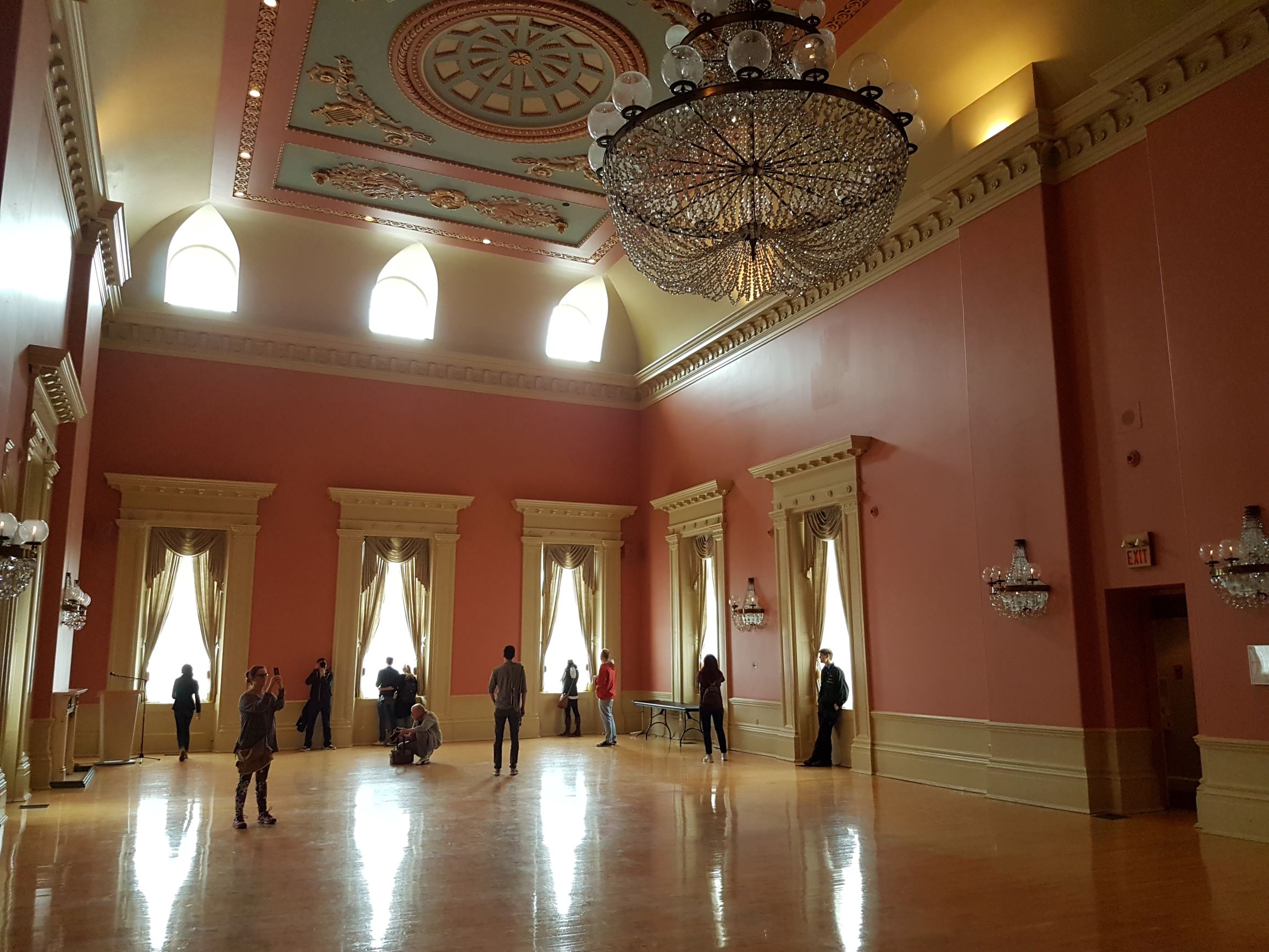 on June 8, 1858 at the beautiful St. Lawrence Hall, which still stands today231—the Great Hall within St. Lawrence Hall is pictured at left.232
He was in good company: Sir John Beverly Robinson, then the Chief Justice of Upper Canada, and John A. MacDonald, then the attorney general of the Province of Canada, were among the numerous distinguished guests. Such was Thomas's status in Toronto society that he, too, was listed among the esteemed guests and sponsors when the event was advertised to the public. The concert apparently attracted a "very large" audience. In the oratorio, numerous vocal and instrumental soloists performed, some having travelled from other cities.233 The orchestra was conducted by a Mr. Noverre, who was also a soloist.234
Acclaim
On January 15, 1859, in his final meeting as President of the Toronto Board of Trade, Thomas was congratulated at the close of the meeting:235
At the conclusion of the election, the following resolution was moved by W.P. Howland Esq., seconded by Rice Lewis, Esq., and unanimously carried.
"That this Board regret that Thomas Clarkson, the late President of the Board for the last six years declined a re-election, and they cannot separate without expressing their high esteem for his character, and for the honourable manner in which he has performed the duties attendant on that office."
Mr. ALEX HAMILTON amid great applause suggested that Mr. Clarkson would be an excellent and highly eligible candidate for Parliament, should an election soon take place.
A political career was not in Thomas's future, however. Instead, he would continue starting and growing businesses, and he continued for one more year as the Toronto General Hospital board member from the Board of Trade.236
Part 6: Milwaukee in the 1860s
How did Thomas capitalize on his fame and seniority in Toronto society?
He left town.
In 1860, as the economic tide had waned and an "unprecedented" recession continued to grip Toronto,237 Thomas and almost his entire family left Toronto for Milwaukee, Wisconsin. Thomas sought opportunity in a region that appeared to be growing rapidly. There, with his sons Benjamin Read and Robert Guy, he established a firm of commission merchants, T. Clarkson & Sons.238
The new firm did business first at 39 and 41 East Water Street in Milwaukee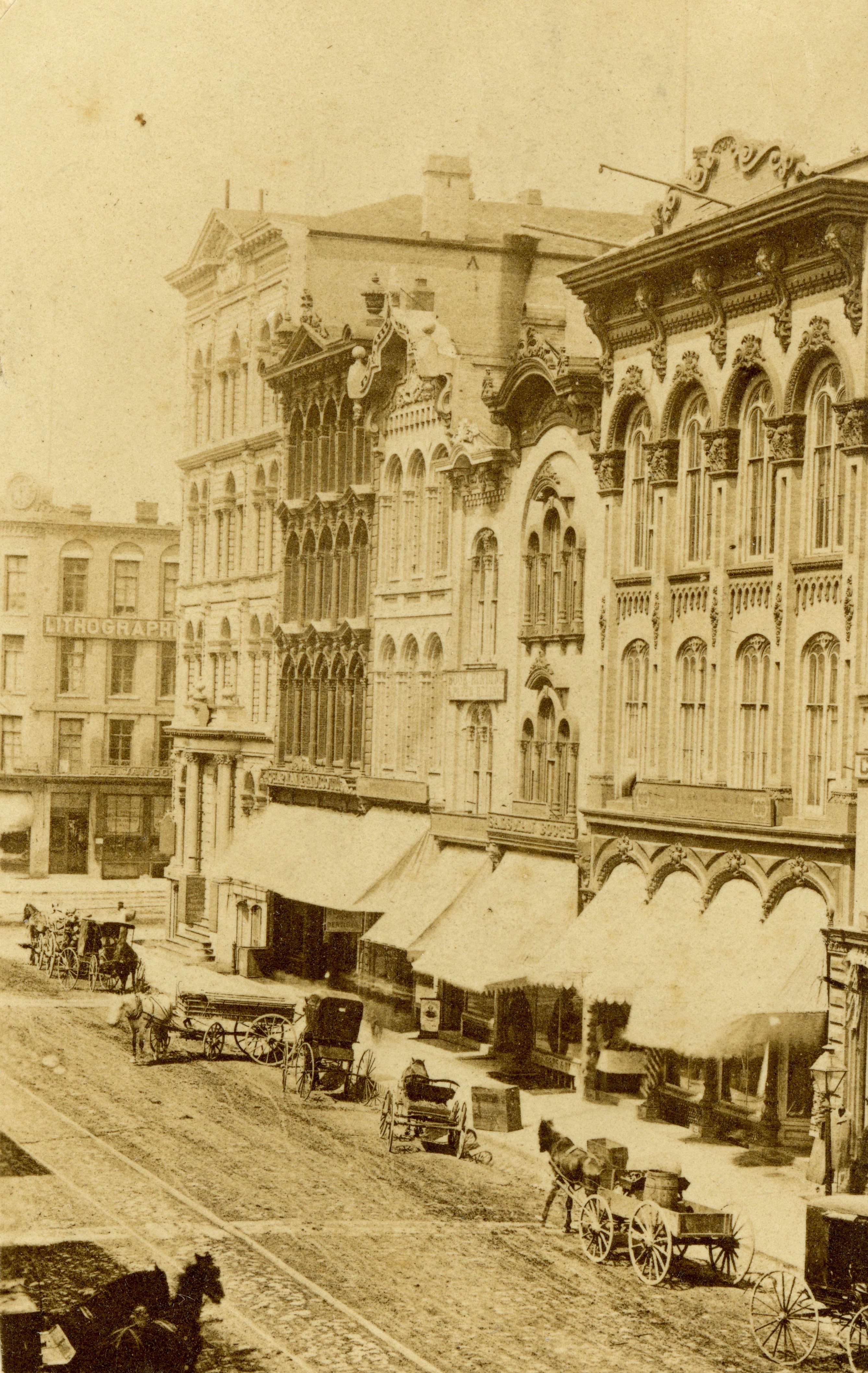 239 (East Water Street is seen at right in 1858240) and then on Spring Street.241 Thomas and his sons did what they knew best, acting as commission merchants. The Clarkson name remained in Toronto on the firm of Clarkson, Hunter & Company, apparently run by George Hunter, which was located next to Thomas's old place of business, at 85 Front Street East.242 Clarkson, Hunter & Company subsequently went bankrupt in 1861, suggesting that Thomas may have erred in leaving it in George Hunter's hands.243
In Milwaukee, Thomas and his sons embraced their new home by establishing their business, joining the Chamber of Commerce,244 and donating money to "missions" at the Methodist Episcopal Church.245 Thomas may also have helped Thomas Jr. establish himself as a grain buyer.246
The 1860 Census of the United States shows Thomas and almost his entire family (except some of the older children, Betsy Faram, John Brunskill, Robert Guy, and Benjamin Read) living in Milwaukee, including Thomas Jr. The following was the data provided in that census:247
Thomas Clarkson, age 55, Merchant, Value of Real Estate - $5,000, Value of Personal Estate - $10,000, born England
Sarah Clarkson, age 40, born Canada,
Thomas Clarkson, Clerk, age 30, born England,248
Louise [ed.: Louisa] Clarkson, age 24, born Canada,
Hadlet [ed.: (Mary) Adelaide] Clarkson, age 13, born Canada,
Aliss [ed.: Alice] Clarkson, age 10, born Canada,
Edward Clarkson, age 8, born Canada,
George Clarkson, age 4, born Canada,
Annie Clarkson, age 2, born Canada,
Dina Holland, age 30, Servant, born Holland
Other than the older children, this census mentions everyone that we expect should be in the Clarkson family, including little Annie Helena, who would only live to the age of four.249 Alexander Mitchell must have been born later that year, after the census date. Robert Guy and Benjamin Read joined their father later, it appears, because they were listed in an 1863 Milwaukee directory and noted to be working for T. Clarkson and Sons—they were the sons referred to.250
Despite this hiatus in Milwaukee, Thomas had made is name in Toronto and would return there to write the rest of his story. The opportunities in Milwaukee were good enough that one of Thomas's sons, Robert Guy, remained in Wisconsin for the rest of his life.251 But as the economic tide continued to wax back in Toronto, Thomas and the rest of the family returned by 1864.252
Part 7: Toronto Redux
Thomas's return to Toronto would be his final move in the pursuit of prosperity. One of the first pieces of evidence that Thomas was back in the Province of Canada is his appointment as an official assignee, of which more is said below. The same day that this appointment was reported in the newspaper,253 Thomas's first advertisement appeared since his return, offering fire and life insurance;254 Thomas was the contact, and he listed his address as 39 Colborne St.
But of these, it was the official assignee business that would leave a lasting mark on the Canadian economy.
While the date of Thomas's return can be established with reasonable certainty by the date of this first advertisement, since Thomas seemed to constantly advertise, his wife and some of their children likely returned by 1863. To see this, note that Thomas's youngest child, Ethel Alberta, was born in 1863, according to her 1866 christening record with St. James Cathedral in Toronto.255 This date accords with the family information.256 All the available subsequent censuses record Ethel Alberta as being born in Canada - some in Ontario, but interestingly, some in Quebec.257 Some of these same censuses show Alexander Mitchell as being born in the United States (which is true) and as having immigrated to Canada in 1860 or 1861, though these dates were given many decades later and so are subject to the degradation of memory.258, 259 So it seems likely that Thomas's wife Sarah returned with some of their children to Canada (and quite possibly to Quebec) from Milwaukee before giving birth to Ethel Alberta. This fact also hints that Thomas may have travelled back and forth while he lived in Milwaukee.
Official Assignee
Ernst & Young is one of the four largest global accounting firms, which are actually groups of associated partnerships.260 The Canadian partnership of Ernst & Young LLP was previously named Clarkson, Gordon & Co., and originated as a business started by Thomas in 1864.261
Thomas returned permanently to Toronto from Milwaukee in 1864, and in that same year the Province of Canada passed the Insolvent Act.262 The Insolvent Act of 1864 mandated the position of "official assignee", an administrator (or today, a receiver or trustee) who would take control of a bankrupt person's assets, dispose of those assets, and pay the person's creditors in a orderly manner.263
The Insolvent Act of 1864 empowered the Boards of Trade of the various cities in the Province to appoint such official assignees.264 Thomas was looking for opportunities in Toronto, and he had excellent connections at the Toronto Board of Trade as discussed above. In a book about the Insolvent Act, Sir James D. Edgar repeated the relevant section of the Act and added notes as follows (with emphasis added):265
4. The Board of Trade at any place, or the Council thereof, may name any number of persons within the County or District in which such Board of Trade exists, or within any County or District adjacent thereto in which there is no Board of Trade, to be official assignees for the purposes of this Act, and at the time of such nomination shall declare what security for due the performance of his duties, shall be given by each of such official assignees before entering upon them; and a copy of the resolution naming such persons, certified by the Secretary of the Board, shall be transmitted to the Prothonotary or Clerk of the Court in the District or County within which such assignees are resident:
[note:]The several Boards of Trade in Toronto Hamilton, London, Kingston and Ottawa, appointed official assignees under the authority of this clause at an early period after the act came into force. The names of those appointed are as follows:
By the Toronto Board: - Messrs. Thomas Clarkson, Thomas Gordon, Joseph Blakely, Samuel Spreull, F.A. Whitney, Henry Joseph, Henry Hewlett, W.T. Mason, and George Wightman for the City of Toronto...
The first of these appointments by the Council of the Toronto Board, including Thomas's appointment, took place July 12, 1864.266 The original announcement in The Globe is shown below left.
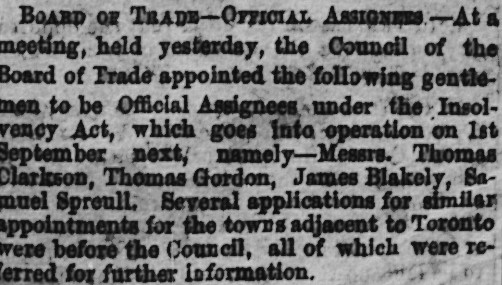
Thomas's previous high level of influence at the Toronto Board of Trade continued to pay dividends for him, more than five years after his resignation as president. His experience with his brother's bankruptcy in Hull all those years before may have given him the confidence to pursue this endeavour.
In order to track the progress of Thomas's early official assignee business, I attempted to assemble a complete list of the firm's clients from its start in 1864 to Thomas's retirement in 1872. Such a list of clients is possible because for any one bankrupt client, Thomas would have to advertise every day for weeks in multiple newspapers leading up to a creditors' meeting, as well as having to advertise dividends and sales of assets. So it should be possible in theory to identify every client of Thomas's business through newspaper advertisements. This search was conducted primarily through The Globe newspaper, which is the only Toronto newspaper that is readily searchable over this period, and augmented with information from The Daily Leader and other sources.
Tracking advertisements, I was able to discern the following numbers of new clients for the years 1864-1872:267
- 1864 - 0
- 1865 - 2 - First client is James Neeland
- 1866 - 11
- 1867 - 22 - Includes a notice in The Globe from July 1, 1867, Confederation Day268
- 1868 - 23
- 1869 - 12
- 1870 - 12
- 1871 - 13 - Only three new client ads between September 17, 1870 and November 13, 1871
- 1872 (to March 4) - 1
A full list of the 96 clients identified is available here.
While Thomas had a slow start as an official assignee, he was ultimately successful. His first announcement for a client did not come for more than a year after he was appointed official assignee.269 This may have been due to the requirement that he deposit $5,000,270 a substantial amount of money at that time, with the Toronto Board of Trade. Because this first advertisement was not repeated, it may have been that this was a false start. By the time he had his second client in December 1865,271 he also ran an advertisement for himself alluding to difficulties in getting started:272
Official assignee under the Insolvent Acts of 1864 and 1865.
Having given the required security to the Board of Trade, and engaged a competent accountant to wind up Bankrupt's Estates, the undersigned is now fully prepared to act as an "Official Assignee" under the said Acts.
Thos. Clarkson, 83 Front Street, Toronto
Parties residing in any part of Upper Canada can appoint an Official Assignee in Toronto, for winding up their affairs in Bankruptcy.
Toronto, Dec. 18.
This reset of the official assignee business seemed to do the trick. The year 1866 produced at least 11 new clients, but his success is particularly evident in 1867 and 1868, with over 20 new clients each year.
As an official assignee, Thomas would regularly hold meetings of creditors of insolvent people or businesses, and would advertise almost daily to alert creditors to such meetings. In fact, one seemingly knowledgeable critic of the Insolvent Act, writing under a pseudonym, described the official assignee's role as involving "too much advertising, too much time wasted, and too many meetings".273
Thomas tried to maintain the privacy of his business operations. When he saw that members of the press were present at one meeting, he asked them to leave.274 In another case, he tried to have journalists removed, but was overruled by the chairperson.275 But we are fortunate that he was not always successful, because transcripts of at least three of Thomas's business meetings were reported in the newspaper, giving us insight to the early workings of the firm.276, 277, 278
Of these three meetings, one is particularly enlightening. The meeting concerned J. G. Beard & Sons, a client of Thomas. J. G. Beard & Sons had been a Toronto business operating for decades, producing iron stoves and being involved in grain handling, but which had then been declared bankrupt.279 Based on the newspaper account, some of the more salient facts were these:280
- J. G. Beard had died, and his sons were being questioned.
- The sons were not sure when they had become insolvent—they believed they were solvent based on information gathered over the prior four years.
- The company owned a grain elevator, which had required $31,000 to build. No entries had been made in the books to reflect this expenditure.
- Two schooners had been owned by the business but had been sold on credit. No entries had been made in the books to reflect these sales.
- The foundry had burned down, insurance money had been collected, and the foundry had been rebuilt. No entries had been made in the books for any of these events.
The full transcript that appeared in The Globe can be found here.
The proprietors of this business clearly did not have the first idea about accounting. For many of the events described, it may not be obvious what entries should be made, but that there should have been some sort of entries is self-evident. This example of a business meeting gives us insight into how a firm that began as an assignee in bankruptcy would realize the need to provide accounting services to Toronto businesses.
The statistics show a decline in advertisements from 1869 onwards, which at first looks like a slow period for the business. But the The Story of the Firm about Clarkson, Gordon & Co. tells the opposite tale. It explains that in 1869,281
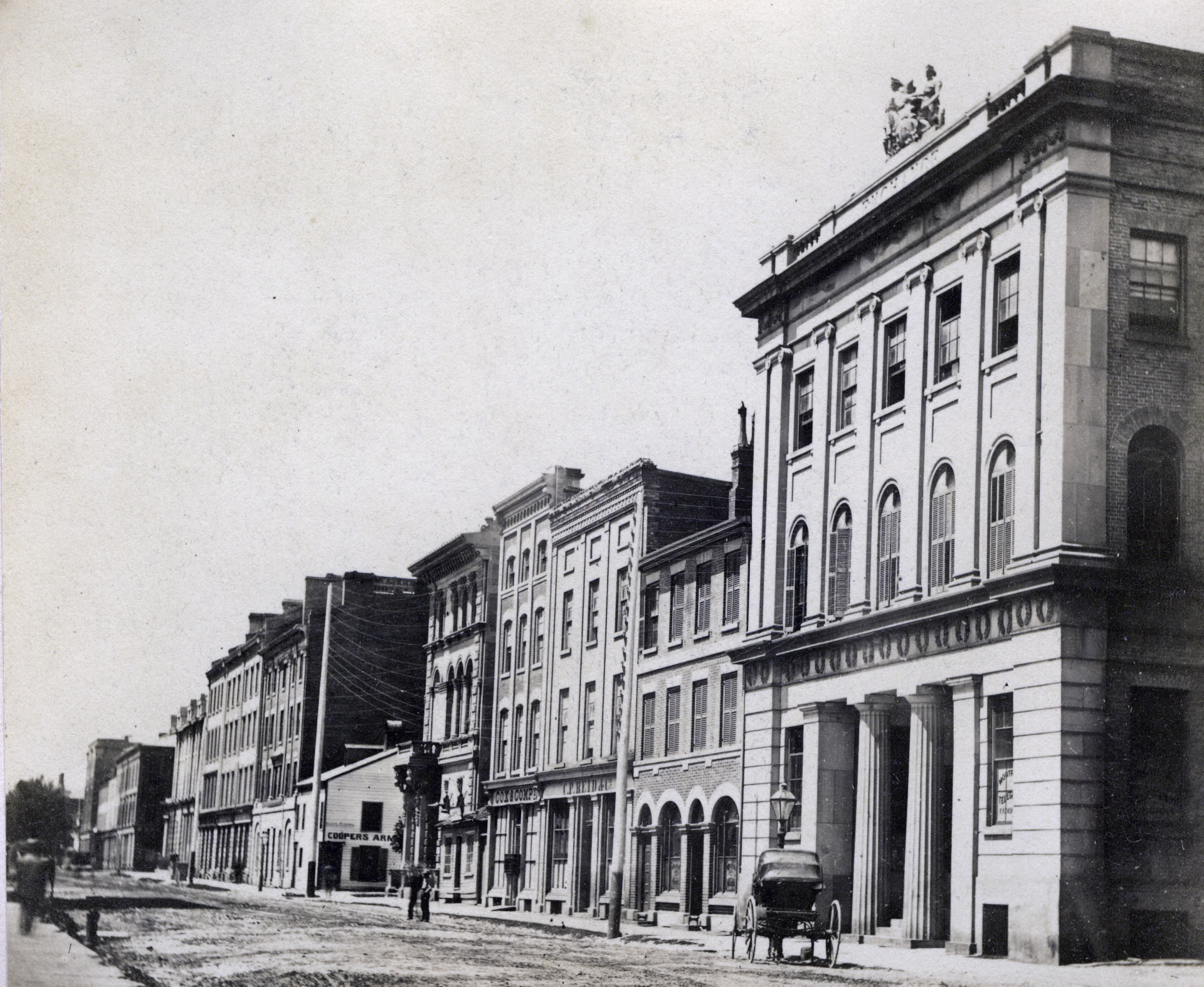
Mr. Thomas Munro [ed.: his name was actually William F. Munro], his senior employee, was spending full time on that business and Mr. Clarkson found that he was turning down new work because of lack of experienced help. Furthermore, he was getting on in years (he was then 67) and was finding the business strenuous. He wrote to his son E.R.C. in September: "I have now a Bankrupt Estate in Penetanguishene—have been there once, rode 80 miles in a stage coach or spring waggon, which was too much fatigue for me."
The year 1870 seemed to be another such year with a number of new clients being listed up to September of that year. At some point during this year, Thomas moved into the Exchange Buildings on Wellington Street East at Leader Lane,282 which are pictured at right.283 Later in the year, the business seems to have gone through a difficult period of more than a year with only three new clients being indicated in advertisements. A careful review of The Globe and The Daily Leader over this period shows a slowdown in bankruptcies generally.284
By the end of 1870, it appears that Thomas's son E.R.C. joined the business as a clerk,285 after some period of his father's urging.286 E.R.C. had been finishing a contract with a wholesale dry goods house in Montreal.287
Despite his engagement with his business, Thomas still had other business interests, advertising as a commission merchant and an insurance agent.288 Thomas also continued to contribute to society in ways that would aid business generally. On May 7, 1867, for example, he was elected president of the Produce and Merchants Exchange Association (also known as the "Corn Exchange"),289 having been on the Board of Arbitrators of that association the previous year.290 He remained president until 1869.291
The difficult period for the assignee business ended with a flurry of new clients being signed on in November and December 1871 and continuing into February of 1872. Thomas's health finally forced his retirement in early 1872. His son E.R.C. assumed the business working in a partnership with Thomas's former senior employee, William F. Munro.292  This was the beginning of ten years of relative instability in the business, which are outlined in more detail here.
E.R.C. continued in his father's business, added accounting to the services offered to Canadian businesses, and was also instrumental in developing the Chartered Accountant designation in Canada.293 During the twentieth century, Clarkson, Gordon & Co., as the firm became known, assumed a leading position in the market for accounting advice, auditing, tax, advisory, and bankruptcy services in Toronto and across Canada.294 Today, the business continues to remember the Clarkson name, as is evident from the photo at left, taken in the firm's offices in the EY Tower at 100 Adelaide Street West.295
The business that Thomas created in just eight years was handed over to E.R.C. with a track record of success.
Clarkson's Elevator
In 1869, Thomas continued his grain trading business with his son Benjamin Read by acquiring a grain elevator from the estate of J.G. Beard. Repainted with his name, "Clarkson's Elevator" sat on the lake front near City Hall at the foot of East Market Street, and near Thomas's offices on Front Street.296 A few years later, the land underneath the elevator was auctioned by the City, and the advertisement for the auction described the elevator as follows:297
Parcel 13. Elevator and Wharf. That leasehold property being water lots adjoining and fronting lots numbers 22 and 23, on which the City Hall is erected, extending the width of the two lots, 139 feet more or less from the southern side of the Esplanade, to the Windmill line... That part of the said lots comprising the Elevator and the Wharf, from 100 feet south of the Engine House, adjoining the Foundry, with a right of way from the Esplanade thereto of 30 feet in width, is now under lease to B. R. Clarkson, Esq., at a rental of $3,000 a year, payable quarterly, which lease expires on 1st September 1875. The leasee has the option of giving 6 months notice of renewing the term for a period of 5 years, at a rental of $3,200.
Thomas began renting the elevator in 1869. He was apparently quite excited about its value, judging by a letter he wrote to his son E.R.C.:298
This is Beard's Elevator we have taken for five years. We have half the net proceeds for working it. I consider this one of the best bargains I ever made - the prospects are that we shall have as much as we can do.
Even at the end of his career, he showed the same zeal for business that had helped him for his entire adult life.
Part 8: Final Years
In 1872, at the age of 70, Thomas suffered a stroke and was forced to retire from business.299 While the exact date of his stroke is not known, the last advertisement I could find with Thomas's name on it appeared in The Daily Leader on March 4, 1872, advertising a meeting that same day regarding the bankruptcy of Eli Shaver and Thomas Bell.300 The first sign that a new order had been brought to the business was an advertisement in The Globe on June 11, 1872 showing that William F. Munro was an official assignee, and naming the new partnership Clarkson & Munro (E.R.C. and William F. Munro).301 So Thomas's stroke likely took place in March or April of 1872.
Thomas's business interests were distributed among certain of his grown sons: his son E.R.C., with William F. Munro, took over his official assignee business, while his son Benjamin Read had already taken over his grain business. His son Robert Guy continued with the business Thomas started in Milwaukee.
Thomas died on May 4, 1874. The Mail newspaper carried the following notice:302
Death of Mr. Clarkson
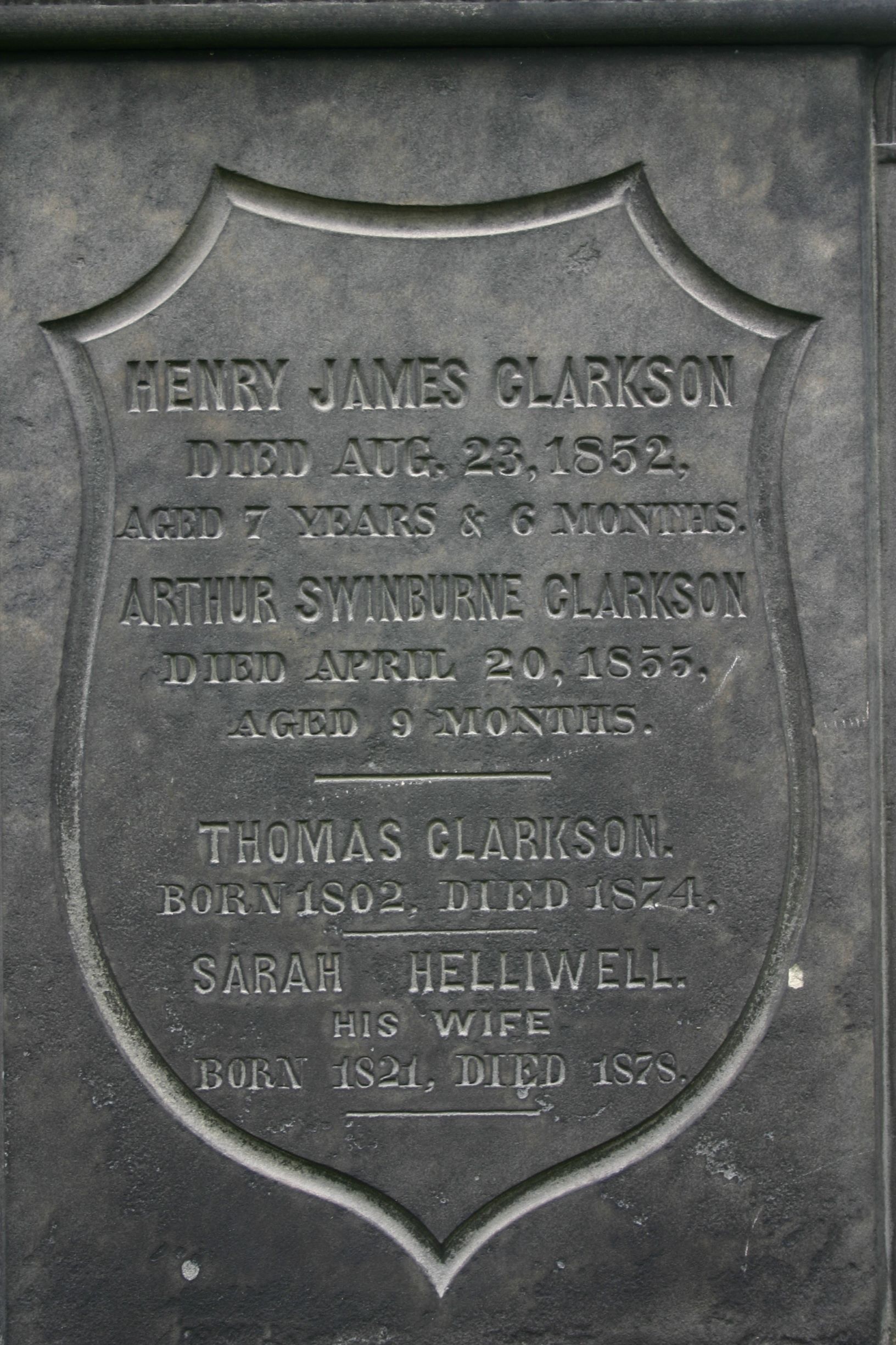
We regret to have to notice to-day the death of Mr. Thomas Clarkson, which took place about four o'clock this morning. Deceased was a resident of the city for over thirty years. He had latterly been one of our leading produce merchants and more than once fitted the post of President of the Corn Exchange Association. He retired from business about two years since, in consequence of a paralytic stroke, which left him in a very delicate condition. He was respected by all acquainted with him, and will be sincerely regretted by very many of them. On receipt of the news of his death, the Corn Exchange Association to-day adopted the following resolution:
Moved by the President, Mr. James Young, and seconded by Mr. W. H. Howland,
"That in respect to the memory of the deceased this morning do now adjourn, and that all members who can do so attend the funeral."
Thomas was laid to rest two days later in St. James Cemetery, alongside two of his sons. The humble inscription on his grave is shown at right.303
The ceremony appears to have been well attended. A notice in The Daily Leader on May 7, 1874 read as follows:304
Board of Trade—The quarterly general meeting of the Board of Trade, advertised to take place yesterday, had again to be postponed, in consequence of there being no quorum. This was chiefly attributable to the fact that Mr Clarkson was being buried. ...
Thomas's funeral attracted a significant number of his former business associates.
Conclusion
Thomas Clarkson was a prominent figure in Toronto's business world, who trained in Hull, England and Hamburg, who became known to most residents of Toronto as a merchant in the 1830s and 1840s, and whose influence reached its zenith in the 1850s. An analysis of the evidence shows that he was a natural businessman who could sell almost anything, though not a natural public speaker. An enthusiastic supporter of free trade, building infrastructure, and the rolling back of restrictions on lending money, he saw great opportunity from unlocking the wealth to be found in the interior of North America. He moved repeatedly in search of opportunity, but once settled in Toronto, he helped to found several major institutions that are important parts of Canadian society today, and guided those and others through their early years. Through these institutions, including the Toronto Region Board of Trade, the Toronto-Dominion Bank, the Canadian firm of Ernst & Young LLP, Ports Toronto, and the Toronto General Hospital, his efforts in the nineteenth century continue to benefit us in the twenty-first century.
Footnotes
1Thomas Clarkson of Toronto, photographer unknown, Toronto Public Library, J. Ross Robertson Collection, call no. JRR 792, scanned by staff of the Toronto Reference Library on August 13, 2020. The title of the photograph is written on the back. This photograph was scanned at my request for the purposes of this biography, and will subsequently be made available as part of the on-line Toronto Public Library digital collection. Because Thomas appears at most middle-aged in this photograph, so it could have been taken no later than the late 1850s, and because photographers only began to practice in Toronto after the 1856 directory was published (in which there were no photographers listed), this photograph can be dated to the late 1850s. See W.R. Brown, Brown's Toronto General Directory 1856, Toronto: W.R. Brown, 1856, p. 298; and W.C.F. Caverhill, Caverhill's Toronto City Directory, for 1859-60, Toronto: W.C.F. Caverhill, 1859, p. 242.
2"Thomas Clarkson—Key Events", The Abolition Project website, http://abolition.e2bn.org/box_59.html, accessed July 8, 2020.
3Frederick H. Armstrong, "Clarkson, Thomas", Dictionary of Canadian Biography, vol. 10, Toronto: University of Toronto/Université Laval, 1972, pp. 173-174.
4A. J. Little, The Story of the Firm, 1864-1964: Clarkson, Gordon & Co., Toronto: University of Toronto Press, 1964.
5David MacKenzie, The Clarkson Gordon Story: In Celebration of 125 Years, Toronto: University of Toronto Press, 1989.
6International Genealogical Index Individual Record for the Christening of Thomas Clarkson, accessed November 26, 2005.
7International Genealogical Index Individual Record for the Marriage of John Clarkson and Elizabeth Smith, accessed November 26, 2005.
8Google Maps satellite image of Susworth, accessed September 20, 2020, copyright Getmapping plc, Infoterra Ltd & Bluesky, and Maxar Technologies.
9Information page on the Medieval Settlement of Susworth on www.pastscape.org.uk, accessed January 3, 2015.
10"Dining Out in Lincolnshire and the Surrounding Area", Tastes of Lincolnshire, December 2004.
11Christening record for Margaret Clarkson, freereg.rootsweb.com, accessed June 7, 2008.
12Information page on the Medieval Settlement of Susworth on www.pastscape.org.uk, accessed January 3, 2015.
13Geoffrey Moorhouse refers to the killing of some noblemen loyal to the crown, and states, "The effect of these murders was to spread the conflagration further, with people who had not yet done so taking up arms and preparing for the worst. Bells were ringing everywhere, beacons were lit along the south bank of the Humber and on Thursday morning the citizens of Beverley, on the other side of the water, awoke to the news that the whole of Lincolnshire had risen between the county town [ed.: Lincoln] and Barton, where there was a ferry crossing of the river, which was almost a mile wide at that point." The area he refers to includes Susworth and its vicinity, which is closer to Barton. Geoffrey Moorhouse, The Pilgrimage of Grace, London: Weidenfeld & Nicolson, 2002, p. 51.
14Joel Murray, Lincolnshire and the Mayflower Pilgrims on the Visit Lincoln website, www.visitlincoln.com/blog/lincolnshire-and-the-mayflower-pilgrims, January 16, 2020, accessed October 5, 2020.
15See, for example, the christening of Thomas's last child, Ethel Alberta Clarkson, in St. James Cathedral in 1865: Emails from Sarah MacDougall, Archives Assistant, Diocese of Toronto, Anglican Church of Canada, July 7, 2020.
16For example, the shift of Thomas's father to Methodism: see "Deaths", Hull Packet and East Riding Times, July 7, 1848, p. 5.
17International Genealogical Index Individual Record for the Christening of Smith Clarkson, accessed July 10, 2006.
18Marriage record of Thomas Clarkson and Elizabeth Faram, England Marriages, 1578-1973, Index, familysearch.org, reference p190 569, FHL microfilm 1,450,407, accessed February 7, 2015.
19Lincolnshire Family History Society, Transcript of Lincolnshire Marriage License between Thomas Clarkson and Elizabeth Fareham, MB 1823/212-214, www.findmypast.co.uk, accessed March 12, 2020.
20Clarkson Family Tree, c1947, said to have been prepared by Elsie Clarkson and Gladys (Anderson) Clarkson, with additions from Edith (Clarkson) Wilkes, filed by George Wilkes in the National Archives of Canada.
21See, for example, Baptisms solemnized in the Parish of Holy Trinity, Kingston-upon-Hull, in the Year one thousand eight hundred and twenty five, p. 499, no. 117 August 10, 1825; and Baptisms solemnized in the Parish of Holy Trinity, Kingston-upon-Hull, in the Year one thousand eight hundred and twenty seven, p. 635, no. 1202, July 24, 1827.
221842 Province of Canada Census record for Thomas Clarkson and family, Toronto (City), St. Lawrence Ward, p. 2.
231901 Canadian Census record for Matthew Teefy and family, Village of Richmond Hill, p. 13.
24Stamp, Robert M., Early Days in Richmond Hill: A History of the Community to 1930, Chapter 8, "Who Was Who in the 1873 Municipal Elections, www.edrh.rhpl.richmodhill.on.ca/defualt.asp?ID=s8.7#p8.7.12, accessed January 3, 2019.
25Clarkson Family Tree, c1947, said to have been prepared by Elsie Clarkson and Gladys (Anderson) Clarkson, with additions from Edith (Clarkson) Wilkes, filed by George Wilkes in the National Archives of Canada.
26Robert M. Stamp, Early Days in Richmond Hill: A History of the Community to 1930, Chapter 8, "Who Was Who in the 1873 Municipal Elections, www.edrh.rhpl.richmodhill.on.ca/defualt.asp?ID=s8.7#p8.7.12, accessed January 3, 2019.
27Baptisms solemnized in the Parish of Holy Trinity, Kingston-upon-Hull, in the Year one thousand eight hundred and twenty five, p. 499, no. 117, August 10, 1825.
28Marriages solemnized in the Parish of Gainsborough in the County of Lincoln in the year 1823, p. 190.
29William Barton(painter), View of the South End, Hull (The Citadel, Hull), Ferens Art Gallery.
30"Lincoln, March 13, Married", The Lincoln Rutland and Stamford Mercury, March 13, 1823, p. 3.
31Edward Banes, History, Directory & Gazetteer of the County of York, Leeds: Edward Baines, 1823, p. 271.
32Edward Banes, The History and Directory of the Towns and Principal Villages in the County of Lincoln including the Port of Kingston-upon-Hull, Leeds: Edward Baines, 1826, p. 94.
33The London Gazette, August 7, 1827, no. 18,385, p. 1701.
34Edward Banes, The History and Directory of the Towns and Principal Villages in the County of Lincoln including the Port of Kingston-upon-Hull, Leeds: Edward Baines, 1826, p. 153.
35See, for example, "Clarkson's Entry, Silver-Street.", Hull Advertiser and Exchange Gazette, February 8, 1806, p. 2.
36Edward Banes, The History and Directory of the Towns and Principal Villages in the County of Lincoln including the Port of Kingston-upon-Hull, Leeds: Edward Baines, 1826, various pages.
37Pigot and Co.'s National Commercial Directory for 1828-29, London: J. Pigot & Co., 1828, various pages.
38Marriage record for John Clarkson and Mary Ann Kirkus, England Marriages, 1578-1973, Index, familysearch.org, FHL microfilm 919,478, accessed November 10, 2019.
39Kathleen A. Hicks, Clarkson and its Many Corners, Mississauga: Mississauga Library System, 2003, p. XVI.
40"Death", The York Herald, August 26, 1890, p. 2.
41The London Gazette, April 15, 1831, no. 18,793, p. 730.
42Marriages solemnized in the Parish of Gainsborough in the County of Lincoln in the year 1823, p. 190.
43Baptisms solemnized in the Parish of Holy Trinity, Kingston-upon-Hull, in the Year one thousand eight hundred and twenty four, no. 3196, January 14, 1824.
44Baptisms solemnized in the Parish of Holy Trinity, Kingston-upon-Hull, in the Year one thousand eight hundred and twenty five, p. 499, no. 117, August 10, 1825.
45The Law Advertiser, volume 3, London: J. W. Paget, 1825, p. 45.
46"For Antwerp, The Twee Gebroders", The Hull Advertiser and Exchange Gazette, April 2, 1824, p. 2.
471842 Province of Canada Census record for Thomas Clarkson and family, Toronto (City), St. Lawrence Ward, p. 2.
48See, for example, "The Alliance British and Foreign Life and Fire Assurance Company", The Hull Advertiser and Exchange Gazette, July 1, 1825, p. 1.
49Edward Baines, The History and Directory of the Towns and Principal Villages in the County of Lincoln including the Port of Kingston-upon-Hull, Leeds: Edward Baines, 1826, p. 154.
50"The Alliance British and Foreign Life and Fire Assurance Company", The Hull Advertiser and Exchange Gazette, July 1, 1825, p. 1.
51Edward Baines, The History and Directory of the Towns and Principal Villages in the County of Lincoln including the Port of Kingston-upon-Hull, Leeds: Edward Baines, 1826, p. 94.
52See, for example, "The Alliance British and Foreign Life and Fire Assurance Company", The Hull Advertiser and Exchange Gazette, October 7, 1825, p. 1.
53Baptisms solemnized in the Parish of Holy Trinity, Kingston-upon-Hull, in the Year one thousand eight hundred and twenty seven, p. 635, no. 1202, July 24, 1827.
54Marriages solemnized in the Parish of Cottingham in the County of York in the Year One Thousand Eight Hundred and twenty seven, p. 74, no. 221, July 26, 1827.
55The London Gazette, August 7, 1827, no. 18,385, p. 1701.
56See, for example, The Post Office Annual Directory for 1830-31, Edinburgh: Ballantyne & Co., 1830, p. 54.
57The London Gazette, August 7, 1827, no. 18,385, p. 1701.
58"Hull", The Hull Packet, February 20, 1827, p. 2.
59Yorkshire, Sheet 240 (map), Southampton: Lt. Colonel James, Superintendent, Ordnance Map Office, surveyed 1853, published 1856.
60"Part 6: HULL - a description." in Bulmer's History and Directory of East Yorkshire, 1892, transcribed on www.genuki.org.uk/big/eng/YKS/ERY/Hull/HullHistoryBaines/HullHistory06, accessed December 21, 2019.
61Edward Baines, The History and Directory of the Towns and Principal Villages in the County of Lincoln including the Port of Kingston-upon-Hull, Leeds: Edward Baines, 1826, p. 21.
62Baptisms solemnized in the Parish of Holy Trinity, Kingston-upon-Hull, in the Year one thousand eight hundred and twenty seven, p. 635, no. 1202, July 24, 1827.
63Pigot and Co.'s National Commercial Directory for 1828-29, London: J. Pigot & Co., 1828, P. 964, among others.
64"Deaths", The Hull Advertiser and Exchange Gazette, June 4, 1830, p. 3.
65Hamburgisches Adress-Buch fur das Jahr 1829., Hamburg: Hermann'schen Erben, 1829, p. 73.
66Hamburgisches Adress-Buch fur das Jahr 1830., Hamburg: Hermann'schen Erben, 1830, p. 64.
67Hamburgisches Adress-Buch fur das Jahr 1828., Hamburg: Hermann'schen Erben, 1828, p. 73.
68Hamburgisches Adress-Buch fur das Jahr 1831., Hamburg: Hermann'schen Erben, 1831, p. 65.
69Hamburgisches Adress-Buch fur das Jahr 1830., Hamburg: Hermann'schen Erben, 1830, p. 64.
701842 Province of Canada Census record for Thomas Clarkson and family, Toronto (City), St. Lawrence Ward, p. 2.
71Thomas Jr.'s age in the 1860 US Census is another piece of information regarding Elizabeth's date of death, though ages in censuses should not be relied upon without corroborating information: see 1860 US Census record for Thomas Clarkson and family, the second Ward of Milwaukee, Wisconsin, pp. 97-98.
72Elizabeth Hancocks(ed.), Potter's Field Cemetery 1826-1855 otherwise called The Strangers' Burying Ground: Bloor and Yonge Streets, Toronto, Ontario, Toronto: Generation Press for Toronto Branch Ontario Genealogical Society, 1983, p. 18.
73The London Gazette, June 14 1831, no. 18,813, p. 1181.
74See results of search of Hull newspapers 1826-1832 here, involving The Hull Advertiser and Exchange Gazette and The Hull Packet, various editions.
75See results of search of Hull newspapers 1826-1832 here, involving The Hull Advertiser and Exchange Gazette and The Hull Packet, various editions.
76See results of search of Hull newspapers 1826-1832 here, involving The Hull Advertiser and Exchange Gazette and The Hull Packet, various editions.
77See results of search of Hull newspapers 1826-1832 here, involving The Hull Advertiser and Exchange Gazette and The Hull Packet, various editions.
78"Hamburg", Encyclopedia Britannica, vol. XI, Edinburgh: Adam and Charles Black, 1880, p. 408.
79Ibid.
80Der Jungfernstieg in Hamburg Um 1830, Wikimedia commons, https://commons.wikimedia.org/wiki/File:Hamburg_-_Jungfernstieg_um_1830.jpg, accessed December 21, 2019.
81Richard Roberts, Schroders: Merchants & Bankers, London: The Macmillan Press Ltd, 1992, pp. 26-27.
82See results of search of Hull newspapers 1826-1832 here, involving The Hull Advertiser and Exchange Gazette and The Hull Packet, various editions.
831842 Province of Canada Census record for Thomas Clarkson and family, Toronto (City), St. Lawrence Ward, p. 2.
84The London Gazette, June 14 1831, no. 18,813, p. 1181.
85A History of the County of York East Riding, vol. 1, London: Victoria County History, 1969, on British History Online, www.british-history.ac.uk/vch/yorks/east/vol1/pp174-214, accessed December 21, 2019.
86Ibid.
87James Alderson, M.D., A Brief Outline of the History and Progress of Cholera at Hull, London: Longman, Rees, Orme, Brown, Green, & Longman, 1832.
881842 Province of Canada Census record for Thomas Clarkson and family, Toronto (City), St. Lawrence Ward, p. 2.
89Henry Scadding, Toronto of Old, Appendix, Toronto: 1873, p. 579.
90Passenger list for the ship New York, District of New York, Port of New York, February 21, 1833, p. 1.
91Looking north on Yonge Street from in front of the Thornhill Hotel (circa 1905), photographer unknown, www.yorkregion.com/community-story/7258771-agriculture-arts-and-athletes-a-look-back-at-thornhill-s-history/, accessed September 28, 2019.
92Record of marriage between Thomas Clarkson and Mary Brunskill, list of marriages solemnized by William Lyle, filed May 12, 1835, Ontario Archives.
93Clarkson Family Tree, c1947, said to have been prepared by Elsie Clarkson and Gladys (Anderson) Clarkson, with additions from Edith (Clarkson) Wilkes, filed by George Wilkes in the National Archives of Canada.
94Elizabeth Hancocks(ed.), Potter's Field Cemetery 1826-1855 otherwise called The Strangers' Burying Ground: Bloor and Yonge Streets, Toronto, Ontario, Toronto: Generation Press for Toronto Branch Ontario Genealogical Society, 1983, p. 18.
95Emails from Sarah MacDougall, Archives Assistant, Diocese of Toronto, Anglican Church of Canada, July 7, 29, and 30, 2020.
96Victoria Clarkson likely had a middle name, since all the other children of Thomas and Mary did. Victoria's christening record has not been found—she was likely christened in haste since she died at the age of five months. Her name and age at death are only known because they appear on the gravestone she shares with her mother, which was moved from Potter's Field to Mount Pleasant Cemetery, but neither the gravestone nor the cemetery record book show her middle name. Note also that the Potter's Field record book lists Victoria's age at 2 weeks, while her gravestone lists her age at 5 months. The latter strikes me as being more credible, since the family would have authorized it directly: See Burials of the York General Burying Ground, p. 57.
97Emails from Sarah MacDougall, Archives Assistant, Diocese of Toronto, Anglican Church of Canada, July 7, 29, and 30, 2020.
98Burials of the York General Burying Ground, p. 87.
99Ibid.
100Elizabeth Hancocks(ed.), Potter's Field Cemetery 1826-1855 otherwise called The Strangers' Burying Ground: Bloor and Yonge Streets, Toronto, Ontario, Toronto: Generation Press for Toronto Branch Ontario Genealogical Society, 1983.
101Ibid, p. 18.
102Clarkson Family Tree, c1947, said to have been prepared by Elsie Clarkson and Gladys (Anderson) Clarkson, with additions from Edith (Clarkson) Wilkes, filed by George Wilkes in the National Archives of Canada.
103Email from Sarah MacDougall, Archives Assistant, Diocese of Toronto, Anglican Church of Canada, July 29, 2020.
104William Helliwell, Untitled (William Helliwell Diaries), Toronto: City of Toronto Museum Services, no date, accessed August 20, 2019.
105Doris M. Fitzgerald, Thornhill: An Ontario Village, Thornhill: the author, 1964, p. 76.
106George Walton, The City of Toronto and the Home District Commercial Directory and Register with Almanack and Calendar for 1837, Toronto: T. Dalton and W.J. Coates, 1837, p. 141.
107Ibid, p. 9.
108Archeological Services Inc., State 2 Archaeological Assessment (Property Assessment), TTC Yonge Street Subway Extension Conceptual Design, Toronto: author, 2011, Appendix A, "Land Use History", page unnumbered.
109Gooderham and Worts, artist unknown, 1840s, Toronto Public Library, Baldwin Collection, call no. X21 Fra. The windmill stood at the foot of Trinity St in Toronto. The Jail (1840-1860) is shown in the background.
110E.B. Shuttleworth, The Windmill and its Times, Toronto: William G. Gooderham, 1924, pp. 76, 81, 91, 96, 102.
111Glen Brunskill, Robert BRUNSKILL / Tamar ARINSON family of York Co. Ontario, posting on Rootsweb: BRUNSKILL-L Archives, http://archiver.rootsweb.com/th/read/BRUNSKILL/1999-09/0937710826, September 18, 1999, accessed July 28, 2006.
112Grave of Mary Clarkson, originally in Potter's Field, York County, moved to Mount Pleasant Cemetery.
113Email from Sarah MacDougall, Archives Assistant, Diocese of Toronto, Anglican Church of Canada, July 29, 2020.
114Elizabeth Hancocks(ed.), Potter's Field Cemetery 1826-1855 otherwise called The Strangers' Burying Ground: Bloor and Yonge Streets, Toronto, Ontario, Toronto: Generation Press for Toronto Branch Ontario Genealogical Society, 1983, page entitled "Inscriptions from Some of the Tombstones Removed from Potter's Field to Mount Pleasant Cemetery", page unnumbered.
115George Brown, Brown's Toronto City and Home District Directory, 1846-47, Toronto: George Brown, 1846, "The Home District Directory", pp. 46, 90.
116British Colonist, December 7, 1852, p. 6.
117Doris M. Fitzgerald, Thornhill: An Ontario Village, Thornhill: the author, 1964, p. 77.
118Letter from Thomas Clarkson to the Mayor and Corporation of the City of Toronto, July 6, 1836, appendix to the Journal of the Common Council of the City of Toronto, City of Toronto Archives Fonds 200, Series 1080, 1836.
119Report of the Select Committee advising the renting of part of the Market Building to Thomas Clarkson for 35 pounds per annum, City of Toronto Archives Fonds 200, Series 1081, Item 253, July 18, 1836.
120"FLOUR.", The Royal Standard, December 7, 1836, p. 3.
121Emails from Sarah MacDougall, Archives Assistant, Diocese of Toronto, Anglican Church of Canada, July 7, 29, and 30, 2020.
122Email from Sarah MacDougall, Archives Assistant, Diocese of Toronto, Anglican Church of Canada, July 29, 2020.
1231842 Province of Canada Census record for Thomas Clarkson and family, Toronto (City), St. Lawrence Ward, p. 2.
124Ibid.
125George Brown, Brown's Toronto City and Home District Directory, 1846-47, Toronto: George Brown, 1846, "The Home District Directory", p. 13.
126York, capital of Upper Canada, showing Court House and Jail, August 1829, Library and Archives Canada, Wikimedia commons, https://en.wikipedia.org/wiki/York,_Upper_Canada#/media/File:Toronto_ou_York_capitale_du_Haut_Canada_ao%C3%BBt_1829.jpg, accessed October 27, 2019.
127"Hamburg", The Illustrated Magazine of Art, vol. 3 no. 14 (1854), p. 103.
1281842 Province of Canada Census record for Thomas Clarkson and family, Toronto (City), St. Lawrence Ward, p. 2.
129Ibid.
130Marriage record of Thomas Clarkson and Sarah Helliwell, Marriage register of St. James Cathedral, Toronto, May 2, 1844.
131Commemorative Biographical Record of the County of York Ontario, Toronto: J.H. Beers & Co., 1907.
132Clarkson Family Tree, c1947, said to have been prepared by Elsie Clarkson and Gladys (Anderson) Clarkson, with additions from Edith (Clarkson) Wilkes, filed by George Wilkes in the National Archives of Canada, corroborated by various other sources.
133Strangely, Henry James Clarkson's baptism is recorded in the records of both St. James Cathedral and Little Trinity Church—both records show the same baptism date and the same birth date. Perhaps someone from each church attended the baptism and then each then recorded in his own books: see emails from Sarah MacDougall, Archives Assistant, Diocese of Toronto, Anglican Church of Canada, July 7, 2020.
134Annie's middle name Helena was confirmed and double-checked by the research team at the Anglican Diocese of Toronto Archives, so I view as incorrect the name "Annie C. Clarkson" that appears in the family record. See emails from Sarah MacDougall, Archives Assistant, Diocese of Toronto, Anglican Church of Canada, July 7, 2020.
135Toronto Herald, Toronto, March 6, 1845.
136Ibid.
137"By Thomas Clarkson & Co.", The Globe, September 10, 1844, p. 3.
138Margaret Atwood, Alias Grace, Toronto: McLelland & Stewart, 1996, p. 200.
139"Toronto Markets", The Globe, October 2, 1844, p. 3.
140Glen Brunskill, Robert BRUNSKILL / Tamar ARINSON family of York Co. Ontario.
141"Dissolution of Partnership", The Globe, February 18, 1845, p. 4.
142John Hillyard Cameron, Esq., Queen's Bench and Practice Court Reports, Toronto: Rollo and Adam, 1861, Vol II, pp. 361-365.
1431842 Province of Canada Census record for Thomas Clarkson and family, Toronto (City), St. Lawrence Ward, p. 2.
144Glen Brunskill, Robert BRUNSKILL / Tamar ARINSON family of York Co. Ontario, posting on Rootsweb: BRUNSKILL-L Archives, http://archiver.rootsweb.com/th/read/BRUNSKILL/1999-09/0937710826, September 18, 1999, accessed July 28, 2006.
145Email from Sarah MacDougall, Archives Assistant, Diocese of Toronto, Anglican Church of Canada, July 7, 2020.
146John Hillyard Cameron, Esq., Queen's Bench and Practice Court Reports, Toronto: Rollo and Adam, 1861, Vol II, pp. 361-365.
147Francis Lewis, The Toronto Directory and Street Guide, for 1843-4, Toronto: H. & W. Roswell, 1843, pp. 25-26.
148George Brown, Brown's Toronto City and Home District Directory, 1846-47, Toronto: George Brown, 1846, "The Home District Directory", p. 9.
149Search of the 1842 Province of Canada Census for family names starting "Br" in Toronto (City) district, 1842 Census of Canada West, Toronto (City).
150The alternatives for the identity of the more distant family member in the 1842 census, which seem much less likely, are that the unidentified family member was either Thomas's brother Smith Clarkson, though there is no evidence that he ever came to Canada, or another of Mary's unmarried brothers.
151George Brown, Brown's Toronto City and Home District Directory, 1846-47, Toronto: George Brown, 1846, "The Home District Directory", p. 13.
152Francis Lewis, The Toronto Directory and Street Guide, for 1843-4, Toronto: H. & W. Roswell, 1843, p. 28.
153See the 1842 Census, with Malachi O'Donohoe being two buildings away from Thomas's location, and then note that in the 1843 directory he is across from the market: 1842 Province of Canada Census record for Thomas Clarkson, Toronto (City), St. Georges Ward, p. 2; and Francis Lewis, The Toronto Directory and Street Guide, for 1843-4, Toronto: H. & W. Roswell, 1843, p. 61.
154"Salt! Salt!!", The Globe, January 20, 1849, p. 24.
155"To Be Let" in The Globe, April 29, 1848, p. 4.
156John Ross Robertson, Landmarks of Toronto, vol. 2., Toronto: J. Ross Robertson, 1896, p. 620.
157Dianne Newell, "Helliwell, Thomas", Dictionary of Canadian Biography, vol. 9, Toronto: University of Toronto/Université Laval, 1976.
15885 Front St. E., photograph by Andrew G. Clarkson, May 19, 2017.
159Front St. E., Yonge to Jarvis Sts., looking e. from e. of Church St., detail, Toronto Public Library, 1875, call number E 1-39f.
160George Brown, Brown's Toronto City and Home District Directory, 1846-47, Toronto: George Brown, 1846, "The Home District Directory", p. 13.
161See the 1842 census showing Thomas's residence next to that of Angus Bethune; note Angus Bethune is shown "near the gas works" in the 1843 directory and "near Princess (St.)" in the 1846-47 directory: 1842 Province of Canada Census record for Thomas Clarkson, Toronto (City), St. Georges Ward, p. 2; Francis Lewis, The Toronto Directory and Street Guide, for 1843-4, Toronto: H. & W. Roswell, 1843, p. 61; and Ibid, p. 6.
162"An Act to incorporate the Board of Trade of the City of Toronto", Cap. XXIV, February 10, 1845, in The Provincial Statutes of Canada, Vol. 2, Montreal: S. Derbishire & G. Desbarats, 1845.
163Douglas McCalla, "The Commercial Politics of the Toronto Board of Trade, 1850-1860", The Canadian Historical Review, Toronto: March, 1969, Vol. L, No. 1, pp. 51-67.
164"An Act to incorporate the Board of Trade of the City of Toronto", Cap. XXIV, February 10, 1845, in The Provincial Statutes of Canada, Vol. 2, Montreal: S. Derbishire & G. Desbarats, 1845.
165Douglas McCalla, "The Commercial Politics of the Toronto Board of Trade, 1850-1860", The Canadian Historical Review, Toronto: March, 1969, Vol. L, No. 1, pp. 51-67.
166"Speeches at the Late Free Trade Meeting", The Globe, February 21, 1849, p. 59.
167"Boots and Shoes", etc., The Globe, August 1, 1850, p. 5.
168St. James Cathedral, Andrew G. Clarkson (photographer), May 17, 2017.
169Frederick H. Armstrong, "Clarkson, Thomas", Dictionary of Canadian Biography, vol. 10, Toronto: University of Toronto/Université Laval, 1972, pp. 173-174.
170St. James's Cathedral, Pew No. 84, Centre Aisle, and Pew No. 87, Centre Aisle, photographed Oct. 26, 2005.
171Email from Sarah MacDougall, Archives Assistant, Diocese of Toronto, Anglican Church of Canada, August 11, 2020.
172"Arrival of the America. Glorious News! Sebastopol Taken!!", The Globe, September 28, 1855, p.2.
173"Celebration of the Victory", The Globe, October 4, 1855, p. 948.
174"The Meeting on Friday Last", The Globe, October 9, 1855, p. 964.
175Ibid.
176Donald Swainson, "MacDonell, Allan", Dictionary of Canadian Biography, vol. 11, Toronto: University of Toronto/Université Laval, 1972.
177W.R. Brown, Brown's Toronto General Directory 1856, Toronto: W. R. Brown, 1856, p. xlv.
178W.R. Brown, Brown's Toronto General Directory 1856, Toronto: W. R. Brown, 1856, after p. 95.
179W.R. Brown, Brown's Toronto General Directory 1856, Toronto: W. R. Brown, 1856, p. lxix.
180"Board of Trade Annual Meeting" in The Globe, January 27, 1852, p. 46.
181Ibid.
182Douglas McCalla, "The Commercial Politics of the Toronto Board of Trade, 1850-1860", The Canadian Historical Review, Toronto: March, 1969, Vol. L, No. 1, pp. 51-67.
183Ibid, pp. 55-56.
184Ibid, pp. 55-56, 58.
185Ibid, p. 56.
186Ibid, p. 55.
187"Reported for the Globe", The Globe, February 13, 1854, p. 3.
188Historical Fast Facts, www.td.com/about-tdbfg/corporate-information/tds-history/historical-fast-facts.jsp, accessed February 9, 2019.
189OSFI Annual Report 2017-2018, Ottawa: Minister of Public Services and Procurement Canada, 2018, p. 9.
190Top Banks in Canada, www.relbanks.com/rankings/top-banks-in-canada, accessed February 9, 2019.
191Top 10 Banks in the United States, www.relbanks.com/usa, accessed February 9, 2019.
192Joseph Schull, 100 Years of Banking in Canada: A History of the Toronto-Dominion Bank, Toronto: The Copp Clark Publishing Co. Limited, 1958, pp. 3-4.
193Bank of Toronto 1868, Church and Wellington, William Notman (photographer), 1868.
194Joseph Schull, 100 Years of Banking in Canada: A History of the Toronto-Dominion Bank, Toronto: The Copp Clark Publishing Co. Limited, 1958, p. 8.
195The Bank of Toronto: Proceedings of the First Annual General Meeting of the Stockholders, Toronto: 1857.
196Ibid.
197Joseph Schull, 100 Years of Banking in Canada: A History of the Toronto-Dominion Bank, Toronto: The Copp Clark Publishing Co. Limited, 1958, pp. 22-26.
198Middleton (ed.), The Municipality of Toronto, a History, Toronto: The Dominion Publishing Company, 1923, p. 444.
199History, Ports Toronto website, www.portstoronto.com/portstoronto/about-us/history.aspx, accessed October 27, 2019.
200Michael Moir, The Toronto Harbour Commission Archives in Urban History Review, Volume 17, number 2, October 1988, pp. 112-115.
201Henry William Vavasour, Toronto, C.W.; Plan shewing the military reserves containing about 182 acres exclusive of the portion leased to the Corporation (detail), Toronto Public Library, call no. T1850/5 small, 1850.
202Rules, By-Laws, and Regulations of the Port of Toronto Passed by the Commissioners of the Harbour of Toronto, Toronto: Hugh Scobie, 1852.
203Michael Moir, "Planning for Change: Harbour Commissions, Civil Engineers, and Large-scale Manipulation of Nature" in Gene Desfor and Jennefer Laidley, Reshaping Toronto's Waterfront, Toronto: University of Toronto Press, 2011, pages unnumbered.
204Oliver Moore, "Can the submersion of the islands be stopped?", The Globe and Mail, September 5, 2020, p. A6.
205Ibid.
206Ibid.
207See, for example, Canadian Almanac and Repository of Useful Knowledge for the year 1855, Toronto: MacLear & Co., 1855, p. 78.
208Toronto General Hospital, Lost Rivers website, www.lostrivers.ca/content/points/torontogeneralhospital.html, accessed August 4, 2015.
209Canadian Almanac and Repository of Useful Knowledge for the year 1852, Toronto: Hugh Scobie, 1852, p. 31.
210The board of the hospital was reformed in 1853, keeping the Board of Trade President as a member. See The Globe, May 31, 1853, p. 258.
211Canadian Almanac and Repository of Useful Knowledge for the year 1855, Toronto: MacLear & Co., 1855, p. 78.
212W.R. Brown, Brown's Toronto General Directory 1856, Toronto: W. R. Brown, 1856, pp. xlvi-xlvii.
213The election of officers of the Board of Trade in early 1857 would have been covered in The Globe on February 12. That day's issue is missing from both the online and microfilm versions of the newspaper. However, a correction in the next day's newspaper seems to imply that William Henderson was the hospital representative, as he would be the next year. See "The Hospital", The Globe, February 13, 1857, p. 2.
214The hospital representative for 1858 was William Henderson. See "Annual Meeting of the Board of Trade", The Globe, February 2, 1858, p. 2.
215"Annual Meeting of the Board of Trade", The Globe, January 17, 1859, p. 2.
216Toronto General Hospital, Lost Rivers website, www.lostrivers.ca/content/points/torontogeneralhospital.html, accessed August 4, 2015.
217Chris Bateman, A Brief History of Early Toronto Hospitals, BlogTO website, www.blogto.com/city/2014/06/a_brief_history_of_early_toronto_hospitals/, June 14, 2014, accessed August 4, 2015.
218The Proposed New General Hospital, The Anglo-American Magazine, Toronto: Maclear & Co., February 1854.
219Ibid.
220"Toronto Hospital", The Globe, May 1, 1855, p. 2.
221Ibid.
222"The Affairs of the Hospital", The Globe, October 2, 1855, p. 940.
223Ibid.
224"Historicist: The Toronto School of Medicine", Torontoist website, January 14, 2017, torontoist.com/2017/01/historicist-toronto-school-medicine, accessed December 28, 2019.
225Our History, University Health Network website, www.uhn.ca/corporate/AboutUHN/OurHistory/Pages/toronto_general_history.aspx, accessed October 12, 2019.
226"Temperance Meeting in St. Lawrence Hall, Feb. 23, 1853", The Globe, March 1, 1853, p. 102.
227"The Maine Law in Toronto", The Globe, August 5, 1852, p. 374.
228Ibid.
229"Temperance Meeting in St. Lawrence Hall, Feb. 23, 1853", The Globe, March 1, 1853, p. 102.
230"The Observance of the Sabbath", The Globe, September 18, 1852, p. 2.
231"Under the Patronage", The Globe, June 3, 1858, p. 3.
232The Great Hall, photograph by Andrew G. Clarkson, May 27, 2017.
233Conyngham Crawford Taylor, Toronto "Called Back," from 1892 to 1847, Toronto: William Briggs, 1892, pp. 207-208.
234In all likelihood, this was Augustin Noverre, a Toronto violinist. For more information on Augustin Noverre, see Helmut Kallman, "Griebel, Ferdinand (Frederick)", Dictionary of Canadian Biography, vol. 8, Toronto: University of Toronto/Université Laval, 1972.
235"Annual Meeting of the Board of Trade", The Globe, January 17, 1859, p. 2.
236Ibid.
237Douglas McCalla, "The Commercial Politics of the Toronto Board of Trade, 1850-1860", The Canadian Historical Review, Toronto: March, 1969, Vol. L, No. 1, p. 51.
238Frederick H. Armstrong, "Clarkson, Thomas", Dictionary of Canadian Biography, vol. 10, Toronto: University of Toronto/Université Laval, 1972, pp. 173-174.
239James B. Kellogg, Annual Statement of the Trade and Commerce of Milwaukee, Reported to the Milwaukee Chamber of Commerce, Milwaukee: Jermain and Brightman, 1863, p. 51.
240Water Street 1858, photographer unknown, in Jeff Beutner, "Yesterday's Milwaukee: Water Street 1858", Urban Milwaukee website, www.urbanmilwaukee.com, January 21, 2014, accessed July 16, 2020. Photograph courtesy of Jeff Beutner.
241A. Bailey (ed.), Milwaukee City Directory for 1863, Milwaukee: Starr and Son, 1863, p. 47.
242Toronto General Directory 1861 Toronto: W. C. Chewett & Co., 1861, p. 152.
243Christopher Robinson, Esq., "The Wisconsin Marine and Fire Insurance Company Bank v. The Bank of British North America", Reports of Casses Decided in the Court of Queen's Bench, vol. XXI, Toronto: Henry Roswell, 1862, p. 288.
244James B. Kellogg, Annual Statement of the Trade and Commerce of Milwaukee, Reported to the Milwaukee Chamber of Commerce, Milwaukee: Jermain and Brightman, 1863, p. 51.
245Minutes of the Fifteenth Annual Session of the Wisconsin Conference of the Methodist Episcopal Church Held in Fond du Lac, Sept. 18, 1861, Janesville, Wisconsin: By Order of the Conference, 1861, p. 25.
246National Archives and Records Administration (NARA), Consolidated Lists of Civil War Draft Registration Records (Provost Marshal General's Bureau: 1863), Record Group 110, NAI 4213514, Archive vol. 1 of 3.
2471860 US Census record for Thomas Clarkson and family, the second Ward of Milwaukee, Wisconsin, pp. 97-98.
248The indication that Thomas Jr. was born in England should be met with skepticism. After 30 years, the only person in the household who had direct knowledge of Thomas Jr.'s place of birth was his father, Thomas. Given Thomas's engagement with his business, he was likely not the person answering the census taker's questions.
249Clarkson Family Tree, c1947, said to have been prepared by Elsie Clarkson and Gladys (Anderson) Clarkson, with additions from Edith (Clarkson) Wilkes, filed by George Wilkes in the National Archives of Canada.
250A. Bailey(ed.), Milwaukee City Directory for 1863, Milwaukee: Starr and Son, 1863, p. 47.
251Frederick H. Armstrong, "Clarkson, Thomas", Dictionary of Canadian Biography, vol. 10, Toronto: University of Toronto/Université Laval, 1972, pp. 173-174.
252See, for example, "London and Lancashire Fire and Life Insurance Companies", The Globe, July 13, 1864, p. 3.
253"City News", The Globe, July 13, 1864, p. 2.
254"London and Lancashire Fire and Life Insurance Companies", The Globe, July 13, 1864, p. 3.
255Emails from Sarah MacDougall, Archives Assistant, Diocese of Toronto, Anglican Church of Canada, July 7, 2020.
256Clarkson Family Tree, c1947, said to have been prepared by Elsie Clarkson and Gladys (Anderson) Clarkson, with additions from Edith (Clarkson) Wilkes, filed by George Wilkes in the National Archives of Canada, corroborated by various other sources.
257See next two references and, for example: 1891 Census record for Mary A. Clarkson and family, district 119 Centre Toronto, sub-district 17 St. James Ward, pp. 43-44.
2581901 Census record for Thomas Helliwell and family, district 116 Toronto, sub-district A, pp. 15-16.
2591911 Census record for Abigail Helliwell and family, district 126 Toronto North, sub-district Quadrant 3, p. 19.
260The Big 4 Accounting Firms, big4accountingfirms.org/the-top-accounting-firms-in-the-world, accessed August 9, 2019.
261"The Ernst & Young Story", www.ey.com/global/content.nsf/Canada/About_EY_-_Our_History, accessed June 19, 2005.
262James D. Edgar, The Insolvent Act of 1864, Toronto: Rollo & Adam, 1864, p.7.
263Ibid., pp.47-49.
264Ibid., p.45.
265Ibid., pp.45-46.
266"City News", The Globe, July 13, 1864, p. 2.
267Various issues of The Globe, The Daily Leader, the Lower Canada Law Journal, and the Canada Law Journal. The advertisements were identified through a search of The Globe newspaper using the search term "Clarkson" and examining each entry. For periods in which there were a dearth of ads, a secondary search was performed using the term "Insolvent" and the results were spot checked, with several more clients identified. Clients in 1867 were augmented by those reported in the Lower Canada Law Journal prior to Confederation and the Canada Law Journal after. Because of a complete absence of ads by Thomas Clarkson from an electronic search of The Globe between Sept. 17 1870 and November 14, 1871, the list of clients was manually double-checked against The Daily Leader resulting in three new clients over this period. Clients in 1871 were augmented by lists of insolvents with their corresponding official assignees which were published in The Globe in the latter part of 1871. The final advertisement was identified through a manual search of The Daily Leader.
268"Insolvent Act of 1864", The Globe, July 1, 1867, p.4.
269"Insolvent Act of 1864", The Globe, August 4, 1865, p.3.
270James D. Edgar, The Insolvent Act of 1864, Toronto: Rollo & Adam, 1864, p.46.
271"Insolvent Act of 1864", The Globe, December 18, 1865, p.2.
272"Official Assignee under the Insolvent Acts of 1864 and 1865",The Globe, December 18, 1865, p.2.
273"The Insolvent Act (To the Editor of the Globe)", The Globe, April 16, 1869, p.2.
274"City News", The Globe, April 30, 1869, p.1.
275"Meeting of Creditors", The Globe, May 29, 1869, p. 1.
276Ibid.
277"Examination of Nelson Botsford, an Insolvent", The Globe, November 6, 1869, p.1.
278"Insolvent Act of 1864, Examination of Henry Graham", The Globe, June 10, 1869, p.3.
279CRM Lab Archaeological Services, 125 The Esplanade Temporary Market Structure: Stage 1 Archaeological Background Study, Toronto: CRM Lab Archaeological Services, August 13, 2014, p.4.
280"Meeting of Creditors", The Globe, May 29, 1869, p. 1.
281A. J. Little, The Story of the Firm, 1864-1964: Clarkson, Gordon & Co., Toronto: University of Toronto Press, 1964, p.13.
282W. Henry Irwin, Robertson & Cook's Toronto City Directory for 1871-71, Toronto: Daily Telegraph Printing House, 1871, p. 52.
283Wellington St. E., n. side, looking w. from w. of Leader Lane, Octavius Thompson (photographer), 1867, Toronto Public Library, Baldwin Collection, call no. Z 1-18.
284Between Sept. 17 1870 and November 14, 1871, observations on the assignee business of Thomas and his competitors were developed by manually reviewing The Daily Leader.
285W. Henry Irwin, City Directory for 1871-72, Toronto: Daily Telegraph Printing House, 1871, p. 52.
286A. J. Little, The Story of the Firm, 1864-1964: Clarkson, Gordon & Co., Toronto: University of Toronto Press, 1964, p. 13.
287The Toronto Board of Trade: "A Souvenir Number", Montreal and Toronto: Sabiston Lithographic & Publishing Co., 1893, p. 150.
288See, for example, "Thomas Clarkson, Insurance Agency, Fire, Life and Marine", The Irish Canadian, June 21, 1865, p. 8; and "Thomas Clarkson & Co.", The Globe, December 23, 1865, p.1.
289"Corn Exchange", The Globe, May 8, 1867, p.1.
290"Produce Merchants' Exchange", The Globe, May 28, 1866, p.2.
291"Trade and Commerce", The Globe, May 5, 1869, p.1.
292A. J. Little, The Story of the Firm, 1864-1964: Clarkson, Gordon & Co., Toronto: University of Toronto Press, 1964, p. 15, though this book has incorrectly stated Mr. Munro's first name.
293Ibid.
294Alan J. Richardson, The Canadian Audit Market in the First Half of the Twentieth Century, December 17, 1999, p. 23.
295Clarkson Gordon Lounge, Andrew G. Clarkson (photographer), March 4, 2020.
296"Chancery Sale", The Globe, November 18, 1874, p. 3.
297Ibid.
298A. J. Little, The Story of the Firm, 1864-1964: Clarkson, Gordon & Co., Toronto: University of Toronto Press, 1964, pp. 12-13.
299"Death of Mr. Clarkson", The Mail, May 5, 1874.
300"Insolvent Act of 1869 and Amendments Thereto", The Daily Leader, March 4, 1872, p. 3.
301"Business Cards", The Globe, June 11, 1872, p. 1.
302"Death of Mr. Clarkson", The Mail, May 5, 1874. Note that The Mail appears to have been incorrect about the time of death, as subsequent publications stated that he had died on May 4, the day before the article in The Mail. See, for example, "Died", The Globe, May 6, 1874, p. 2.
303Helliwell Grave, Detail, photograph by Andrew G. Clarkson, May 28, 2005.
304"Board of Trade", The Daily Leader, May 7, 1874, p.2.
