George Austin and Eliza Pedder
Life and Times
George Austin, father of Mary Eliza Austin, was born in Woodstock, Oxfordshire, the son of George Austin Sr.1 As a young man, he travelled to the Isle of Wight, where he met Eliza Pedder. She was the daughter of John Pedder and Elizabeth Chestle.2 George Austin and Eliza Pedder were married in Alverstoke, Hampshire on November 24, 1813.3 Their daughter, Mary Eliza Austin, was born soon after (in about 1814) on the Isle of Wight.4
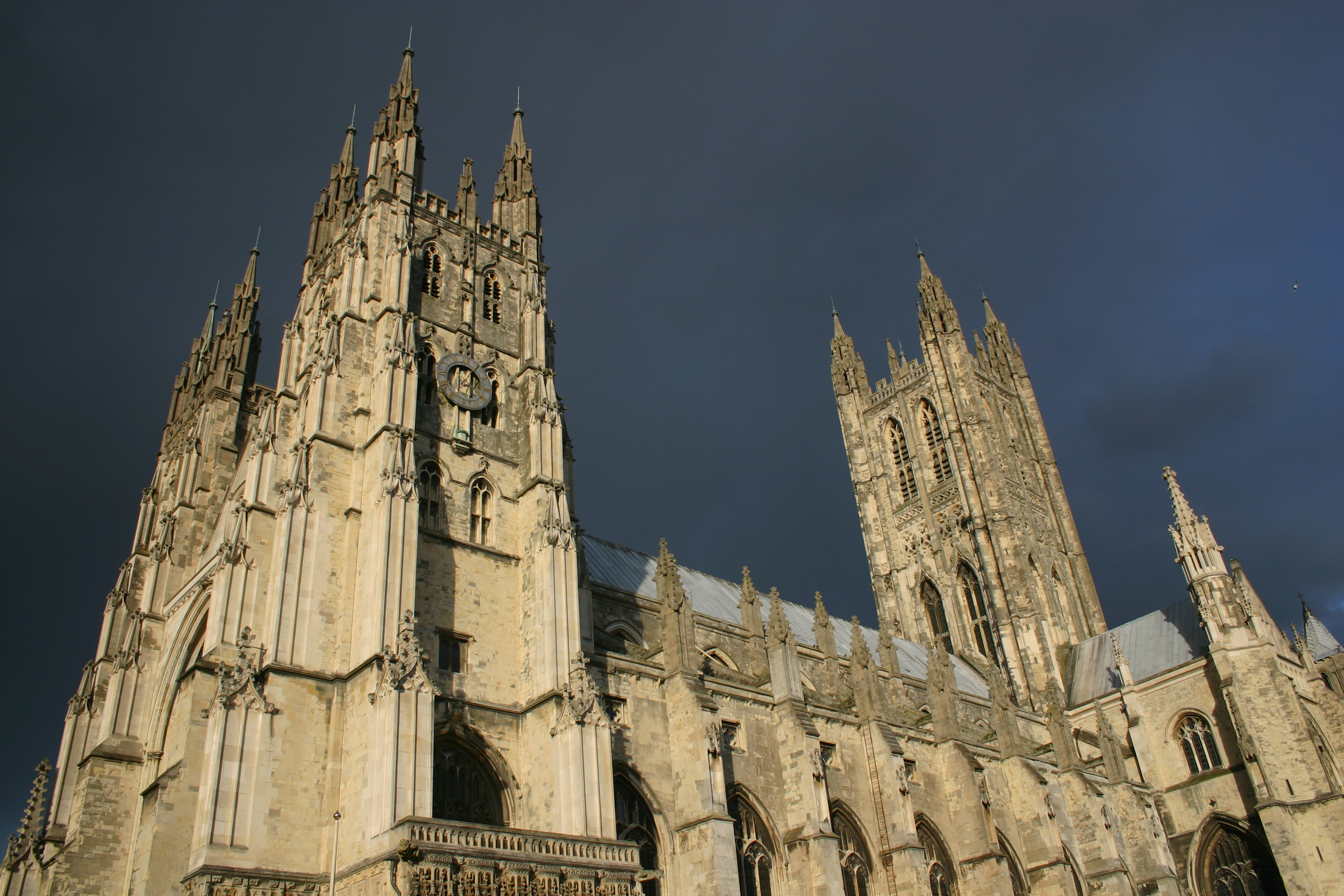 For reasons unknown, the Austin family then moved to Canterbury, Kent. George, whose father was a building surveyor, recognized immediately the significant structural problems with the decaying Canterbury Cathedral, pictured at left, 5 and proposed that they be fixed urgently. He was promptly hired as surveyor and architect, which began a life-long struggle to first save and then preserve the Cathedral, one of the most important churches of the Church of England. George Austin died on October 26, 1848. His son Herbert George Austin assumed his job.6
George's accomplishments are remarkable: he saved the Cathedral, he pioneered the restoration of medieval stained glass, and he designed many key improvements to the interior of the building. His accomplishments were eloquently recognized shortly after his death by The Builder magazine, in an article published on May 5, 1849. It is entitled "The Late Mr. Austin, the Resident Architect of Canterbury Cathedral", and is reprinted here in its entirety:7
For many years up to about 1819, the cathedral of Canterbury had been allowed to run to decay, the only moneys laid out on the fabric being those barely sufficient to keep the roofs dry and the main walls from falling. Some of the most beautiful portions of the cathedral, as they became decayed, requiring more skill or outlay to repair them than was possessed by the director of the workmen, or was approved by the treasurer, were gradually swept away: amongst the latest destructions we may mention the beautiful turret, which surmounted the staircase of the north-west transept.
It was at this time that Mr. Austin being a resident in Canterbury, suggested the absolute necessity of some repairs and works in order to save the main fabric from falling into such a state as would endanger its existence; and by the praiseworthy exertions of the Bishop of Carlisle, then Archdeacon of Canterbury, the building was afterwards placed under his care, with directions for the suggested works to be carried out.
It would be impossible in the space of a short notice to recapitulate the various works found necessary and undertaken by Mr. Austin, or the many ingenious methods adopted to overcome the difficulties which surrounded him, with a comparatively small annual sum to lay out, and a building of such extent and magnitude, requiring extensive repairs in every part, --but amongst them we may mention that the south-eastern transept, through long neglect, and worse measures adopted for its relief (as, for example, a number of massive unsightly wooden pillars in the interior of the cathedral),--so much so that it was considered necessary that it should be pulled down, in order to save the surrounding portions of the cathedral, but no workmen had been found who would venture on the work of demolition. By and ingenious mode, Mr. Austin removed the superincumbent weight from the walls, forced them into an upright position, and firmly fixing them there, reset the large oriel and other windows, which had assumed all kinds of shapes; and, taking off the massive groining of the roof, re-turning the arches, replacing such portions of the ribs as had fallen, and removing the wooden supports in the interior, restored the transept to its former beauty. After some years, the Norman gable, which had been taken off years before to relieve the crumbling walls, was rebuilt, and the walls are now firm and strong.
The whitewash, accumulated for centuries on the interior of the building, was removed, and the whole face of the walls and pillars restored, including the innumerable small purbeek pillars, which were refaced by a composition made by the architect; and the bosses and ornaments of the roofs and tower were gilded and pointed, according to their former state.
During these works, a great number of half-destroyed wall paintings were discovered, drawings from which were made, and are now in the possession of his family. [ed.: These drawings are now in the posession of the Cathedral Archives, where I viewed them in 2006.] At the time the stained glass of the cathedral, which stands unrivalled for its beauty, was much in need of repair, having suffered greatly from ignorant workmen; but the art of staining glass being considered at low ebb, it was thought irreparable. Mr. Austin, however, undertook himself to restore some of the worst lights, and the vacancies of one or two other lights of figures he filled with new glass,--though without the slightest previous knowledge of the art; and it is told to us (we do not remember to have noticed the fact ourselves) that the imitation is so curiously correct that many artists, when asked to point out the new glass, have failed to fix on the right lights.
The most difficult work of Mr. Austin was perhaps the north-western tower. The ancient Norman tower which originally occupied this site, and against which the present nave was built, had long been found to be in a dangerous condition; and in order to relieve the walls, the spire which once surmounted this tower was removed about a century since. This tower had at last become so ruinous that portions fell during every storm, and it gave unmistakeable signs of falling towards the north, in which direction the wall of the nave, deprived of its support on that side, began to heel over, and the groining in consequence was much crippled. At this juncture Mr. Austin, by a combination of mechanical power, after separating the nave walls from the falling tower, raised the crippled groining, and strained the walls into their upright condition, fixing them there until the new tower might be built and be sufficiently set to withstand the lateral pressure. The old Norman tower was then taken down and the present tower erected,* for which the foundation required care, the site having been once a bog or marsh, which was clearly proved by the remains of plants &c, there found; and lower down, 16 feet from the surface, were discovered the entire skeletons of a man and an ox, in such positions as to render it almost certain they had been smothered by sinking in the soft soil.
In the interior of the cathedral many restorations were executed by Mr. Austin. The old painted organ, the case of which entirely stopped up the fine arch between the choir and the central tower, was removed, and the various movements of the organ and its multitudinous pipes were arranged in the triforium thus opening the view from the westernmost end to the extreme east.
The incongruous oaken screen and altarpiece which surrounded the choir, and reduced it to half of its ancient proportions, was removed and the beautiful screen of Henry d'Estria brought to light and restored, and the altar carried back to its ancient position. The present altar screen was then designed and erected, forming a veil, through the fretted openings of which the most beautiful and interesting portions of the cathedral are seen. In clearing away the rubbish for the foundation of this screen, and directly beneath the spot fixed upon by Mr. Austin for the altar table, were discovered the remains of the ancient high altar, surrounded by the jasper pavement, the destruction of which, in the fire of 1174, is described by Gervase, the contemporary of Becket. This would serve to shew the correctness of Mr. Austin's views as to the restoration.
The new throne, illustrated by us some time since, was the last addition to this cathedral by Mr. Austin. [ed.: The illustration referred to is shown below.8] The design is in character with that of the altar screen, and also with a design for the erection of stone stalls, which were proposed to be substituted for the present oaken ones (a design which was preferred to those of Mr. Blore and Mr. Rickman, who also sent in drawings), but which were afterwards abandoned by the dean and chapter, and for the greater part erected, in the short space of about six weeks, in order that it might be ready for the triennial visitation of the archbishop. The ornamental parts were prepared by workmen who had been employed in the cathedrals of Brussels and Cologne, as Englishmen could be obtained at the moment. It was erected at a cost of about 1,200l., which was defrayed by the last archbishop, whose armorial bearings ornament the interior of the throne. It has been proposed to paint and gild some portions of the throne and altar screen, but we are not anxious that this should be done.
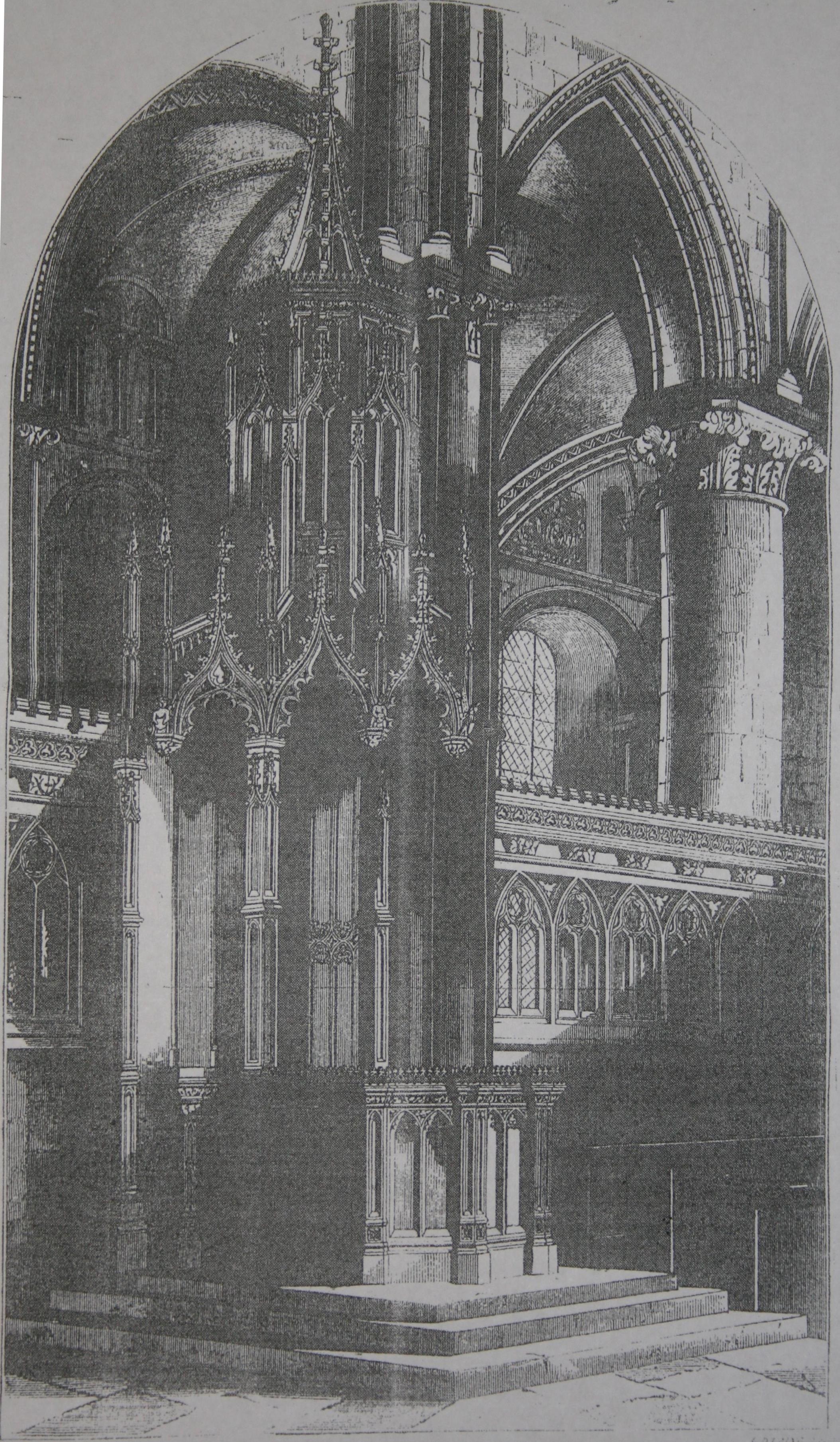
In justice to Mr. Austin it should be stated that the stone pulpit which has been lately erected opposite the throne was not erected by him or from his design, though some portions of it were afterwards altered and adopted by him.
Mr. Austin, to whom it may be justly said all admirers of ecclesiastical architecture are indebted, died in October, 1848, having held office under the dean and chapter for thirty years; and it was a graceful act of the dean and chapter, by which even his death was rendered a continuation of the services of his life in beautifying the cathedral, that they have directed the large window in the north-western tower to be filled with stained glass in his memory. Mr. Austin died at the age of 62, and was a native of Woodstock, being born in "Chaucer's house." It should be remembered, when estimating the merit of his work, that he was one of the earliest of those who gave attention to the restoration of our cathedrals, and began the good work which has of late years been so largely carried out.
* We do not enter into the question which arose as to the propriety or otherwise of retaining the early design.
George Austin was not without his detractors, and in fact an entire book was published to complain about how he had done a shoddy job at surveying someone's property, and how a court of law had performed a shoddy job of siding with him. The book's full title was "A Tenant's Statement of the Conduct Recently Pursued Towards Him by the Dean and Chapter of Canterbury on the Occasion of His Renewing his Lease. With an Appendix Containing The Whole of the Extraordinary Evidence of their Surveyor, Mr. George Austin, before the Parliamentary Committee on Church Leases, and a Complete Refutation, from Documents, of That Person's Statements."9 After such a long title, there is hardly anything left to say about the matter.
George Austin's commitment to art and archetecture not only saved one of the most important churches in England, and helped start the trend of stained glass restoration, but also exercised the talent and appreciation for the arts that was inherited from his father, and would be passed down to his children, grandchildren and subsequent members of his family.
Footnotes
1Colvin, Howard Montague, A Biographical Dictionary of British Architects, 1600-1840, 3rd edition, London: Yale University Press, 1995, p. 80.
2Perkins, John, Modified Register for John Pedder, self published, Novmeber 6, 2006, p. 1.
3Alverstoke, Hampshire marriage record for George Austin and Eliza Pedder, November 25, 1813.
41851 UK Census Record for Alfred B. Lambe and family, City of Westminster, Parish of St. George Hanover Square, p. 28.
5Canterbury Cathedral Against Storm Clouds, photograph by Andrew G. Clarkson, March 2, 2006.
6Colvin, Dictionary of British Architects, p. 80.
7"The Late Mr. Austin: Architect of Canterbury Cathedral" in The Builder : an illustrated weekly magazine, May 5, 1849, vol. 7 no. 26, p. 205.
8"The New Throne in Canterbury Cathedral" in The Builder : an illustrated weekly magazine, November 18, 1848, vol. 6, p. 138.
9Heseltine, W, A Tenant's Statement of the Conduct Recently Pursued Towards Him by the Dean and Chapter of Canterbury on the Occasion of His Renewing his Lease, 2nd Edition, London: Smith, Elder, and Co., 1839.
Andrew G. Clarkson | 
Copyright 2012-2023 | All Rights Reserved
Website design is based on a template by: Genealogy Web Creations